Monday, April 11, 2016

Religion Today on KSL

People have been asking me about Religion Today because Martin Tanner went through the topic yesterday. Martin's a great guy. He has favored the Central American theory for many years and is part of the citation cartel (Interpreter, fairmormon, etc.).

I discussed the program back in August here. The program yesterday may have been a repeat.

Yesterday, he suggested people look at the Book of Mormon text itself and set aside preconditions (a great idea, but I've yet to see a single Mesoamerican do this, and Martin is no exception, as I'll show). The Mesoamerican lenses are quite powerful; those who have worn them for a long time "can't not see" Mesoamerica in the text, as I'll show here. Martin also recommends that people disregard what early leaders, including Joseph Smith, said. He said Joseph never claimed revelation about where BoM events happened, and that "his own personal ideas changed a great deal over time." Consequently, Martin says, Joseph merely speculated. This is all standard citation cartel dogma, the kind of thing one says when looking through the Mesoamerican lenses.

According to Martin, the promised land as described in the Book of Mormon talks about an "advanced civilization," a place where people reached an advanced state of culture and building. According to Martin, just that concept alone disqualifies anything in North America and qualifies the Central American location. Martin claims there are no "great civilizations" in North America between 600 BC and 400 AD. The Mesoamericans had millions of people and walled cities with great buildings. He claims these are absent from North America.

Martin makes basically the same argument the Federal Government did when, pursuant to Manifest Destiny and the approval of the Courts of the Conquereors (as the Supreme Court called itself), the government 1) fought the Indians, 2) removed them from their native lands, 3) forced them onto oppressive reservations, and 4) destroyed as much of their history and as many of their structures as it could. The Illustrated Encyclopedia of Native American Mounds & Earthworks (not LDS) noted that "the large majority of America's mounds have been completely destroyed by farming, construction, looting, and deliberate total excavation...I am fairly certain that over 1,000,000 mounds once existed and that perhaps 100,000 still exist."

Populations, according to Martin, are too large for North America. Hundreds of thousands up to millions. There is no objective evidence that there was any kind of civilization in North America that had millions of people as part of a city or as part of a battle or series of battles. But there are such in Central America.

In my view, it's audacious to claim there is no evidence when we know it was intentionally destroyed, but despite the destruction, the documented earthworks in North America demonstrate a high degree of civilization, both in terms of cooperative effort and in knowledge of math, geometry, and celestial events (including calendaring). Martin is either unaware of this or is misleading his listeners (and I like to think the former).

Martin says there are "No great cities made of cement like we read in the Book of Helaman," or of walls and towers in North America. Now that he's asking his listeners to stick to the text, you would think he would do so, but he doesn't. (I'll assume here that he honestly thinks the text speaks of "cement cities" because that's what everyone who wears the Mesoamerican lenses sees, but readers and listeners need to know Martin's not talking about Joseph Smith's translation.)

Here's what I wrote back in August:

Martin claims there were "cement cities," but there are four references to cement in the BoM, and none of them describe cement cities:

Helaman 3:7
7 And there being but little timber upon the face of the land, nevertheless the people who went forth became exceedingly expert in the working of cement; therefore they did build houses of cement, in the which they did dwell.

Helaman 3:11
11 And thus they did enable the people in the land northward that they might build many cities, both of wood and of cement.

Helaman 3:9
9 And the people who were in the land northward did dwell in tents, and in houses of cement, and they did suffer whatsoever tree should spring up upon the face of the land that it should grow up, that in time they might have timber to build their houses, yea, their cities, and their temples, and their synagogues, and their sanctuaries, and all manner of their buildings.

Testimony of JS-“Having removed the earth, I obtained a lever, which I got fixed under the edge of the stone, and with a little exertion raised it up. I looked in, and there indeed did I behold the plates, the Urim and Thummim, and the breastplate, as stated by the messenger. The box in which they lay was formed by laying stones together in some kind of cement. In the bottom of the box were laid two stones crossways of the box, and on these stones lay the plates and the other things with them.

So, Joseph uses the term "cement" to describe the box--in New York. Besides Joseph's own description (and the even more detailed description by Oliver Cowdery), there is abundant evidence of the North American Indians using cement. Many of the mounds were covered with cement, to the point that they were difficult for farmers to tear down. Some used jackhammers to break up the cement. Even today, at Cahokia, they have recreated a portion of the ancient wall around the city. It consists of tall timbers, covered with cement. 

The scripture says they built houses of cement, and cities "both of wood and of cement." While there may have been Mesoamerican cities made of wood and cement, the ones cited in the 1842Times and Seasons articles that started the Mesoamerican theory are all stone and cement (referring to Teotihuacan and the cities discovered by Stephens and Catherwood). Maybe the Book of Mormon says they built cities and pyramids out of stone and cement, but not in the version I have. 

Must be in the Sorenson translation.

One reference says they built walls of stone around the cities, but the cities were built with mounds of earth--which is what the Hopewell in North America did, including the mounds Joseph described as Nephite. Consequently, in my opinion the cement verses exclude Mesoamerica as a potential location described by the text. (And that's not even getting into the law of Moses problem with Mesoamerican architecture.)

Martin claims that agriculture was limited in North America, but not on the large scale and not with the kinds of grains described, that there are no flocks and herds raised by Native American cultures, etc. He doesn't cite any verses, so I don't know what "large scale" he's referring to, but North American cultures developed agriculture after 600 BC, which museums throughout the Southeastern U.S. explain.

Martin says that in Mesoamerica, they had significant efforts to raise and keep llamas, alpacas, goats, and other herded animals. I've visited Mesoamerica, but the only llamas and alpacas I've seen were in Peru. Llamas and alpacas are called "the sheep of the Andes." Maybe they thrive in hot lowland jungles, but that's news to me.

Martin says the description in BoM of major public buildings, including religious ones, is found in Mesoamerica, but not in North America at all. Hmm. Since he doesn't cite verses, it's hard to know to what he is referring. King Noah built "many elegant and spacious buildings" and "a spacious palace," but they were ornamented with wood not stone and precious things, including gold, silver, iron, brass, and copper. The massive earthworks in North America were "major" by any measure.

He recommends An Ancient American Setting for the Book of Mormon by John Sorenson. He's going through the evidence, based on the text itself.

Martin says there were a number of large-scale of wars between 600 BC and 400 AD but not archaeological evidence in North America, but they do exist in Central America, along with the implements of war. In North America we have some spears, bows and arrows, occasionally other kinds of weapons, such as axes and hatchets. But what we have described in the BoM is swords. We do find swords described in ancient Mesoamerica. Also scimitars, completely absent in North America, but used in Central America. Head shields and body armor in text, but not in North America except for only ceremonial headresses that wouldn't be worn in battle. In Mesoamerica, there are murals showing this kind of thing. Head shields, body armor, etc.

This one sounds like it came from the old Sorenson list. It's so thoroughly uninformed that I won't waste time detailing the problems (I've done that many times before). Anyone with an open mind can find out how many thousands of weapons have been recovered throughout North America. You can see the head plates in museums in Ohio, as well as the breast plates, arm bands, etc.

Martin claims there are no human-made improved roads in North America. In Central America, where the rainforest grew at tremendous rates, the cultures built improved roads to prevent overgrowth. It makes sense in Mesoamerica but not North America, etc.

Seriously? Start with the great Hopewell road, here.

Martin says great towers not found in North America but found in Central America. If he means stone towers, I completely agree. But nowhere does the text refer to stone towers, and there is evidence of abundant wooden towers in North America.

Martin points out there was writing and record keeping in Mesoamerica, but not North America. Spanish gathered them up and burned them, but we still have some. Mesoamerican codices held in libraries, including the Vatican. Plus glyphs on temples. No known books written by Native Americans in North America. The Windtalkers had an advantage of not having a written language to be consulted to allow the Japanese or Germans to break the code.

This is one of my favorite Mesoamerican arguments, because it only makes sense if you're wearing a good pair of Mesoamerican spectacles. As soon as you take them off, you see the argument disproves Mesoamerica. The whole point of the plates was to preserve the history and teachings because the Lamanites would destroy them. The people of Zarahemla had no written language, and they lived in the main city. King Benjamin told his sons that but for the plates, "we must have suffered in ignorance, even at this present time (130-124 B.C.), not knowing the mysteries of God... were it not for these things... we should have been like unto our brethren, the Lamanites." (Mosiah 1). If they were living in Mesoamerica, they could have put the records on the stones and in the codices. Instead, they wrote on plates of metal. The only carved stone in the entire text is the one Coriantumr left with the people of Zarahemla, who couldn't read it. It's difficult to imagine a description more different from Mesoamerica than what the Book of Mormon gives us with respect to writing and record keeping. Not only that, but we have the Mesoamerican records! True, the Spanish destroyed many of them, but we know when the kings lived, what they worshiped and how, etc. The Book of Mormon, by stark contrast, is a lost record of an otherwise unknown history.

Martin asserts that the Nephites followed several calendar systems, but no known calendar systems in North America. That's a compound error, often addressed elsewhere.

Martin claims another thing described in great detail, refining of gold and silver to make plates, described by the Spanish when they got here. None discovered among Native Americans before 400 AD.

The only known smelting in the Americas from Book of Mormon time frames was in Indiana.

Martin raises the old straw man: No hint of cold or snow in BoM, but we would have it if was located in North America.

The New Testament doesn't mention cold or snow, yet I was in Cappadocia recently, where Paul traveled, and it was snowing in April. Does this mean the New Testament could not have taken place where it says it did? It's a goofy argument, even by Mesoamerican standards. Maybe if I put on the Mesoamerican spectacles I could find references in the text to the rainy and dry seasons of Mesoamerica (along with all the volcanoes and jade and tapirs, etc.). What the text does say is there were "some seasons of the year" when fevers were "very frequent in the land." In Mesoamerica, you have two seasons: wet and dry. You can't have "some seasons" when there are only two seasons. In North America, you have four. Anyone familiar with Church history knows that there were "some seasons of the year" when fevers were "very frequent in the land" around Nauvoo.

Martin claims the river Sidon is described as having a "head" up in the south, implying that it ran north from some southern mountain ranges. No North American rivers work for that. But the Grijalva river does work.

This is fully addressed in Moroni's America for anyone who still thinks this is an issue for the North American setting. You'll see you need to wear Mesoamerican spectacles to make any sense out of Martin's argument (which is not at all based on the text, btw).

Martin points out that in Alma Chapter 2, wading across the river Sidon, way up high in the south. Where are you going to wade across the Mississippi or Missouri?

How about at Zarahemla, across from Nauvoo? And around St. Louis?

I admit, it's annoying to keep pounding these rhetorical gophers into the ground. The Mesoamericans have always resorted on incorrect facts, fallacious arguments, and their own additions/modifications of the text. Once they admitted that when you put on the Mesoamerican lenses you can't not see Mesoamerica everywhere, the gig was up.

More and more people realize it. If you're not sure yet, take off the Mesoamerican lenses and think for yourself, reading the text as Joseph translated it. You'll be surprised at how obvious the North American setting is.

:)


Fun with volcanoes

Lava in Guatemala that doesn't exist if you're wearing Mesoamerican lenses

Today I want to have some fun with volcanoes.

There's another new translation of the Book of Mormon making the rounds--again. This one adds "volcanoes" to the text. You won't find this translation on lds.org, and the term is not found in any official version of the text, but you will find it in numerous "scholarly" articles and presentations by the usual suspects (the citation cartel). Like the Sorenson and other new translations, the "volcano" translation is produced by a new kind of seer; i.e., those who "see" or "find" Mesoamerica in the Book of Mormon.

Here's a good explanation, from BYU's Daily Universe of all places:

“There has been a shift more recently to finding Mesoamerica in the Book of Mormon instead of finding the Book of Mormon in Mesoamerica,” he said. “Once you start looking at the Book of Mormon through a Mesoamerican lens, you can’t unsee it.”

That last sentence pretty well explains the whole reason for this blog. Thanks to a historical mistake from 1842, millions of people have been indoctrinated to read the Book of Mormon through a Mesoamerican lens and now they "can't unsee it."

They're stuck.

And so they produce new translations that reflect what they "see" through the Mesoamerican lens. (Maybe we should go ahead and call it the Mesoamerican Urim and Thummim, because that's how authoritative these new translations have become.)

Here's the process by which these new translations are developed:

1. Assume a Mesoamerican setting because of the anonymous 1842 Times and Seasons articles.
2. Put on the Mesoamerican lens (or eyeglasses, or spectacles, or Urim and Thummim).
3. "See" a hill in Mesoamerica that "fits" the text. Reject the New York Cumorah (along with David Whitmer, Oliver Cowdery, and Joseph Smith, because they were merely relying on a folk tradition started by unknown Mormons, they were unreliable people anyway, and they didn't have the Mesoamerican lenses that would have given them the correct understanding that modern scholars have achieved.
4. "See" such things as headwaters, a narrow strip of mountainous wilderness, tapirs, jade, etc.
5. "See" volcanoes.

I'm going to stop at volcanoes today.

[BTW, I mentioned at the conference a few days ago that I have a manuscript titled "Because of This Theory" that I'll probably never publish, but I'm tempted. The title comes from Joseph Fielding Smith's apt observation about the two-Cumorah theory: "Because of this theory some members of the Church have become confused and greatly disturbed in their faith in the Book of Mormon." My manuscript is a collection of "greatest hits" from the citation cartel, but I suppose everyone who follows this topic has their own lists. There is no shortage of material. For example, look at FairMormon's treatment of President Smith's comment here. Maybe we'll have some fun with that one down the road.]

Okay, back to volcanoes.

For years, I've been told about volcanoes in the Book of Mormon. Here's the kind of question you get from CES people (or anyone indoctrinated by CES, BYU, etc.): "Where is the evidence of volcanic activity (3 Nephi 8) in the North American setting for the Book of Mormon?"

I always respond to this by asking where is the evidence of volcanic activity in the Book of Mormon? The people supposedly lived in Central America for 1,000 years and never once mentioned volcanoes?

Of course, when you're wearing Mesoamerican spectacles, you simply read the evidence into the text. You can't not see the volcanoes.

According to the Mesoamerican seers, if you don't see volcanoes in the text, you're wrong; you just need to put on the right spectacles.

I'm going to give some examples next, but first I want to emphasize what I've said from the outset: I know many of the Mesoamerican proponents, including some of the authors of the articles I cite in this post. I like every one of them on a personal level. I consider them brothers and sisters in the gospel. I intend no offense, and I don't criticize any of them. I'm focused solely on the words on the page, the evidence and arguments made, etc.  Whenever you read the ad hominem attacks in FARMS, Fairmormon, BMAF, the Interpreter, etc., I hope you chalk it up to desperation, as I do. The last resort of a losing argument is to attack others personally. I don't care who wrote any of these articles; actually, I wish they had left them anonymous the way Benjamin Winchester did in the Gospel Reflector and the Times and Seasons.

________________________

Here's a fun one to start with: Volcanism and Earthquakes in the Book of Mormon found here. Check out this quotation from the introduction: "The main reason for the article on the BMAF website is to show that the events that occurred throughout the Book of Mormon could not possibly have been located in the eastern half of North America."

I've pointed out before that BMAF is essentially a club for Mesoamerican seers; i.e., people who wear the Mesoamerican spectacles. They are only interested in archaeology, anthropology, etc., "within a Mesoamerican context." They don't even purport to be neutral, let alone objective. The organization exists to perpetuate the Mesoamerican setting. I have no problem with that; in fact, it's delightful, sort of like a Klingon fan club.

So this article fits right in. Most of it is quotations from others who wear the Mesoamerican lenses, so I'm only going to focus on the original material.

The premise, of course, is that 3 Nephi describes volcanoes. Somehow Mormon supposedly described all the things a volcano did but didn't think to simply write, "Volcanoes erupted." That's no problem when you read the text with the Mesoamerican spectacles, though; the word is apparently on every page, invisible to anyone not wearing these specs.

To save time and space, I'll make interlinear notes.

Research has shown that there are no volcanoes east of the Rocky Mountains in North America, aside from four extremely ancient ones: one in Mississippi dating to 65 million years ago; two in New Hampshire that last erupted 400 million years ago, and one in Missouri, the last eruption of which was one-and-a-half billion years ago. [In other words, research has shown that North America, east of the Rocky Mountains, is just like the place the Book of Mormon text describes--no volcanoes in the time frame during which the Nephites and Lamanites inhabited the land.] 
Earthquakes, also, are extremely rare in the US heartland. Dr. Nibley mentioned the earthquake in 1811 of New Madrid, Missouri, down in the very southeast corner of the state. There have been no reports of any earth tremors since then 
[This BMAF article is so badly researched I'm surprised it didn't show up as a "peer-reviewed" article in the Interpreter. This section leads me to conclude that the Mesoamerican spectacles also serve as filters on Google (which actually explains an awful lot of the nonsense you read in Mesoamerican publications). In one minute on google, I discovered this:
Small earthquakes and tremors occur frequently in Missouri. Thousands of quakes have been noted in the state since 1795 and have been recorded since 1908. In recent times, earthquakes have been known to rock tall buildings and crack plaster in Missouri homes. Most were accompanied by numerous aftershocks, which are a series of successive quakes that can cause more damage than the initial shock.
In another minute, I found this:  

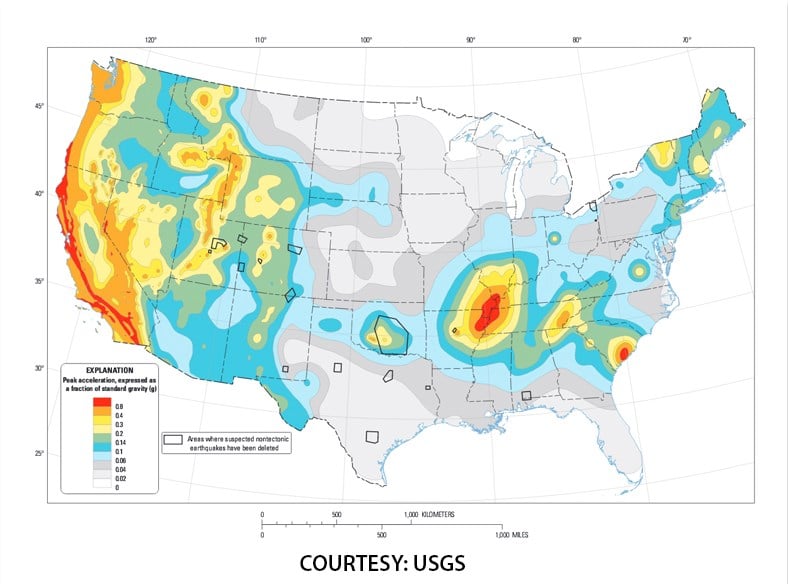
USGS increases earthquake risk along New Madrid Fault

Posted: Jul 22, 2014 3:34 PM MDTUpdated: Jul 22, 2014 3:36 PM MDT

Courtesy: USGSCourtesy: USGS
LOUISVILLE, Ky. (WDRB) -- The midwest region is preparing for earthquakes that are bigger and more powerful than ever believed imaginable.
The U.S. Geological Survey updated their seismic hazards map last week, and in it, Kentucky is listed as one of 16 states at highest risk of earthquakes.
USGS says the New Madrid Fault, which runs through a number of midwestern states, has been identified as an area that has potential for larger and more powerful quakes than previously thought.
But wait. There's more. The Central United States Earthquake Consortium is so concerned about future earthquakes that they are working with FEMA and the USGS to educate and prepare people. See here. 
I suggest BMAF loan some of their Mesoamerican spectacles to the Federal government to alleviate these concerns. 
Pay particular attention to the next part of the BMAF article:
and there appears to be no indication if there was any earthquake activity before 1811, especially around the time of Christ; 
Everyone who has followed the Mesoamerican theory knows the Mesoamerican spectacles filter out everything published by the Smithsonian, including its first publication (Squier and Davis). Here's another example. I took me another minute on google to find this:
"two decades ago, paleoseismology expert Martitia Tuttle and her colleagues began dissecting “sand blows” in the five states surrounding New Madrid. The sand blows were left by geysers when debris surged up through narrow dikes and landed in wide mounds. “Sand blows tell a dramatic story of the widespread shaking of these large earthquakes,” she says.
Tuttle’s team excavated potsherds, spear points and corn kernels and realized that many of the sand blows were more than 200 years old. “Some had archaeological sites on top of them with 2,000-year-old artifacts,” Tuttle says. “There’s no way the New Madrid earthquakes were a one-time freak event.” The Midwest had been slammed by violent quakes around A.D. 1450 and 900 and 2350 B.C.—and probably more often.
Read more: http://www.smithsonianmag.com/science-nature/the-great-midwest-earthquake-of-1811-46342/#pffkcYHByOxTZaZe.99

If a quick google search locates evidence of 2,000-year-old archaeological sites in the Midwestern U.S. on top of remains from earthquakes, what accounts for the claims in the BMAF article? I suggest two possibilities. One, the Mesoamerican spectacles blind the wearers to any evidence that contradicts their theory. Two, see number one.  
Or maybe an archaeological date 2,000 years ago is too inaccurate for BMAF. Maybe they think Christ visited the Nephites in 34 A.D., so the correct archaeological date should be 1,982 years ago, and the 18 year discrepancy excludes North America from consideration.
Now, here's more from the article.
whereas there are minor earthquakes that occur almost weekly and major ones that happen every few years in Mesoamerica. [Normally, the term "whereas" denotes a distinction, but here, the article is making a claim about Mesoamerica that is identical to what happens in the Midwestern U.S. Apparently those Mesoamerican spectacles also reveal Alice-in-Wonderland definitions of ordinary words.] 

Volcanoes are a way of life in Mesoamerica with at least two of them smoking all the time outside Antigua, Guatemala. At least two volcanoes erupted in Mesoamerica closely around the time of Christ’s crucifixion. [Here, the author makes my point; i.e., if the Nephites lived in Mesoamerica, how could they have avoided a single mention of this important "way of life" for 1,000 years? I've been to Antigua. I got a painting of the city with the volcano in the background. You can see it from miles around. But you can only see it in the text of the Book of Mormon if you're a Mesoamerican seer. On the point of the volcanoes erupting 2,000 years ago, assuming that is an accurate statement (unlike the other statements of fact in this article), it can mean only that Samuel the Lamanite was referring to far more than the local area when he made his predictions. 3 Nephi itself never mentions volcanoes.]
Some people make note of the multiple tornadoes that occur in the heartland of America (Tornado Alley), stating that one or more tornadoes would account for the destruction that has been mentioned. [Classic straw-man argument. I've read a lot of stuff on this topic, and I've yet to see a single claim that tornadoes alone would cause all the destruction in 3 Nephi.] Even half-a-dozen tornadoes occurring simultaneously, although causing much devastation, would not produce all the factors that are discussed in 3 Nephi, especially the poisonous gases that were developed. [Agreed, but this is an argument against a claim no one has made. Do the Mesoamerican lenses force the wearers to make logical fallacies? This sentence also provides another example of the Mesoamerican seers coming up with their own translation. Their 3 Nephi has "poisonous gases" arising. Maybe this is a good time to point out that, as always, I concede that Mesoamerica fits their new translations. That's axiomatic. If they would only take off their Mesoamerican lenses for a moment, though, they would see that Mesoamerica does not fit the text Joseph and Oliver translated.] Only a volcano could produce those effects. [Well, another ten seconds of google searching produces the accounts from the New Madrid earthquakes in which people describe conditions exactly like those described in 3 Nephi. E.g., https://en.wikipedia.org/wiki/1811%E2%80%9312_New_Madrid_earthquakes Notice that the New Madrid victims did not report volcanic eruptions--but neither does the Book of Mormon.]
Mention was also made of the possibility of a hurricane being involved in 3 Nephi. The only place in the western hemisphere where a hurricane, volcanic eruption, and a major earthquake happening at the same time is in Mesoamerica and the nearby Caribbean area. [So now we add "hurricane" to the text, on top of "volcanic eruption." Even during the decades when I accepted the Mesoamerican theory, I didn't see these words in the text. Maybe my professors forgot to give me a pair of specs so I could play along. I love this argument, though. "Mention was made" by other Mesoamerican seers, therefore we need to find a place where there are hurricanes and volcanic eruptions, and the only place is Mesoamerica. Do people really not see the Alice-in-Wonderland nature of these arguments?]
________________________

The next article to discuss is titled "“Thick Darkness”: Volcanoes and the Historicity of the Book of Mormon." It's found here.

While this article is as fun as the first one, it has a little more serious implications. The gist of the article is that Joseph Smith could not have been an eyewitness to a volcanic eruption, so he could not have described one "with such vividness and accuracy." Of course, the author is wearing the Mesoamerican spectacles; the text Joseph and Oliver translated doesn't mention volcanoes.

The reason I say it has serious implications is that what the text describes is fully consistent with the reports from the New Madrid earthquakes from 1811-1812. IOW, the BMAF argument folds back on itself; instead of proving Joseph couldn't have written 3 Nephi because he hadn't experienced a volcanic eruption, the article supports anti-Mormon arguments that Joseph could have been simply repeating what was known about the New Madrid events.

This is a typical outcome of articles written by the Mesoamerican seers. Their desperation to prop up an indefensible theory of geography leads them to make claims that undermine the text.

Here's an example from this article. "When readers truly understand the nature of massive volcanic eruptions, their evaluation of Joseph Smith in Palmyra, New York, in 1829 will be that the New World crucifixion-of-Christ events recorded in 3 Nephi 8 show, from a historicity perspective, that Joseph Smith translated, not merely authored, the Book of Mormon."

Arguments such as this are persuasive only to Mesoamerican seers; if you're not wearing the Mesoamerican lenses, then you can't see the term "volcano" anywhere in the Book of Mormon. Like other Mesoamerican arguments, this one boils down to the assertion that Joseph just didn't translate the text correctly, so we have to supply the terms he overlooked.

Here's another missing term supplied by the Mesoamerican Urim and Thummim: "That wording clearly suggests the presence of poisonous volcanic gases that are commonly associated with volcanic eruptions and that can be fatal to those who breathe the air filled with those gases."

The article goes on to cite Mount St. Helens and Vesuvius as examples of volcanoes that caused widespread destruction. I've visited both of those sites and a major feature of each is the volcanic ash. I know people in the military who spent months in Washington cleaning up the ash. Yet, unless you're wearing the Mesoamerican lenses, you can't find a single reference in the text to all this ash.

Here's one of my favorite lines from the article: "The singular, most remarkable thing about 3 Nephi 8 is that it is obviously an eyewitness account of the events that commonly take place during certain kinds of massive volcanic eruptions." 

I can't wait to see an actual, detailed account of a "massive volcanic eruption" that doesn't mention either the volcano or the ash (let alone the lava). The author provides no such account as an example--except for the account in the Book of Mormon itself.

The author cites Payson Sheets' account of a volcanic eruption in Central America in the second century A.D. Here's what Sheets also had to say: "After the eruption, the area could not sustain its entire population and there­fore groups of Protoclassic people emigrated to sites where they might hope to establish new homes."

By contrast, what does the Book of Mormon say? Instead of abandoning the land, as the people in Central America and Pompeii did and the people in Washington would have but for modern mechanized equipment, the Book of Mormon people rebuilt the cities, including Zarahemla. The land was not covered with thick ash.

In most cases, when you remove the Mesoamerican lenses, you realize that the arguments made by the Mesoamerican seers disproves their own theory. Here, the claim that 3 Nephi describes massive volcanic eruptions is contradicted by the text itself.

IOW, not only does the otherwise detailed account in 3 Nephi never once mention volcanoes or volcanic ash, the Nephites immediately rebuilt the cities, which would have been impossible if they had been buried in volcanic ash.

Here's another fun quotation: "Kowallis also says that “Central American volcanoes are so explosive that liquid lava is rarely erupted. Instead, almost all (99 percent) of the magma erupted out of Central American volcanoes is in the form of ash and pumice. This would perhaps explain why there is no mention in the 3 Nephi account of anything that sounds like lava flows.”

Juxtapose this with another quotation from the article: "A “great mountain” took the place of the city of Moronihah, and hills and valleys took the place of other cities. The Book of Mormon wording for these events describes aptly the city of Paricutin, Mexico, west of Mexico City. In the 1940s, a volcanic eruption caused the earth to cover the entire village. Thereafter, the only visible evidence of the village is the Catholic church steeple that pokes up through the lava."

So first the text never mentions lava because Mesoamerican volcanoes don't produce lava, but then the text specifically describes lava as the "great mountain" that "took the place of the city of Moronihah." The proof is that a city in Mexico was completely covered with lava except for the steeple of a Catholic church.

You need to wear Mesoamerican lenses to think this is a coherent argument.

Finally, I'll just note what the official text says. Readers should remove their Mesoamerican spectacles for a moment, if possible.

3 Nephi 8:10 And the earth was carried up upon the city of Moronihah, that in the place of the city there became a great mountain.

How is earth "carried up upon" a city? I'll leave it to you to figure that one out, although it's pretty simple if you aren't wearing Mesoamerican lenses.

Hint: It's not a lava flow...

:)


Wednesday, March 23, 2016

First chapter of Brought to Light

Several people have been asking me about Brought to Light. I'll discuss it more in two weeks, but for now, here's the opening section of Chapter 1:

Church history is a delightful topic on its own, but it also gives us insights into our own roles in the Restoration. The early members of the Church were courageous, confident, and compassionate, but also complex. Like us, they were not perfect. They had strong testimonies of the truth, but struggled to live up to their aspirations. Despite their weaknesses, and in the face of strong opposition, they achieved miraculous success in building the foundation for today’s Church.
I wrote this book to share what I think are faith-affirming historical facts about one of the least-understood figures of Mormon history—Benjamin Winchester. Like me a year ago, I suspect you have never heard of Benjamin Winchester (unless you read my previous book, The Lost City of Zarahemla). He has become a footnote character in Church history, known—if at all—as a troublemaker. A month before he was murdered in Carthage, Joseph Smith said that Benjamin Winchester “had a rotten heart” and “would injure the Church as much as he could.” As you’ll see, Winchester was a far more influential figure than has been previously recognized, just as Joseph warned.

If you’ve read Teachings of the Prophet Joseph Smith, studied the Church lesson manual Teachings of the Presidents of the Church: Joseph Smith, or viewed Book of Mormon artwork on the walls of Church buildings, you’ve seen the work of Benjamin Winchester. This book presents evidence that articles we have long attributed to Joseph Smith were actually written by Winchester. He was one of the “ghosts in the print shop,” meaning he was one of the authors of unattributed material in the Times and Seasons. Some of it was published anonymously, some under pseudonyms, and some signed simply “Ed.” for editor. 

As I showed in The Lost City of Zarahemla, Winchester started out as an enthusiastic young missionary and Church leader, a close friend of Wilford Woodruff, William Smith, Parley P. Pratt, Erastus Snow, and Joseph Smith himself. His enthusiasm grew into zealotry and self-righteousness that brought him into direct conflict with Church leaders and, eventually, apostasy. Hence Joseph’s description.

One way that Winchester injured the Church was providing what would become the basis for the Mesoamerican theory of Book of Mormon geography. That was the topic of Lost City. The book you’re reading now expands beyond that specific point to look at other ways in which Benjamin Winchester left his mark on the Church.

Basically, I propose that Joseph Smith did not write the unattributed editorials in the 1842 Times and Seasons. (The Times and Seasons was the early Church newspaper equivalent of today’s Ensignand Liahona.) These editorials have long been incorrectly attributed to Joseph, conferring a quasi-scriptural importance on them that persists to the present day.


I hope the evidence brought to light in this book will affirm the faith of those who accept the latter-day restoration of the Gospel. But it may require some changes in thinking as well.

Brought to Light buyers

I was surprised at how many people bought the ARC of Brought to Light. Thanks to all of your. Some have already given me some valuable input. Please send your comments to lostzarahemla@gmail.com.

The ARC is no longer available on Amazon. Everyone who purchased a copy can send me an email with your address and I'll make sure you receive a copy of the final version when it's released.


Saturday, March 19, 2016

Brought to Light ARC (Advanced Reader Copy)

I'm trying something new today.

Many people following this blog have asked when Brought to Light will be released. I wanted to release it in February, but there is so much material it was a lot of work to decide what to omit. We ended up removing about 150 pages to put in another book (Tentatively titled The Editors: Joseph, William, and Don Carlos that will come out later in April). Even with that material removed and some extreme editing, the book is 424 pages now. (For various reasons my publisher wants me to cut another 50 or so pages, so this ARC probably has more material than will appear in the final version.)

We have a formal release date for Brought to Light: April 6, 2016, when it will also be available on Kindle. However, the ARC that I send to my beta readers has been going out and I thought you might be interested in an early look.

Here's the description that will be on Amazon (slightly different from what's on there now):

This book is a follow-up to The Lost City of Zarahemla. Lost City uncovered a conspiracy from 1842 in Nauvoo, Illinois, that used anonymous articles in the Times and Seasons to promote a Mesoamerican archaeology for the Book of Mormon by claiming Zarahemla was in Guatemala. Joseph knew nothing about that claim until after the paper was published. He put an end to it and resigned from the paper as a result, but the damage was done. Even today, 174 years later, many Mormon scholars cite the Zarahemla article because they are unaware of the conspiracy and continue to promote the false idea that Joseph Smith taught the Mesoamerican setting for the Book of Mormon. This book offers abundant new evidence about Benjamin Winchester and his work at the Times and Seasons that has never been published before. The new disclosures have implications beyond the Book of Mormon geography question, including clarification on what Joseph taught about the role of women in the Church.

I'll have a lot more to say about this on April 6th, but for anyone interested, you can go to Amazon, which has the ARC for $12.99. Just search for "Brought to Light Neville" and you'll go right to it. (Amazon is interested in what people search for.)

Actually, there are 2 versions there; the $19.99 will be the final version on April 6, The ARC will drop from Amazon on March 25.

BTW, my beta readers send me feedback, so if you get an ARC, you're expected to do so as well.
:)

BTW 2. Some of the critics following this blog have a history of using ARCs to find fault with errors and omissions that are fixed in the final version or subsequent editions, contrary to their agreements to give me feedback on the ARC directly. Maybe this time you'll reconsider that practice?

Thursday, March 17, 2016

Plainness

This is a cross post adapted from the 2016 gospel doctrine page.

2 Nephi 31-33 don't directly contain any information relating to historicity; instead, they tell us how to find answers to our questions and how to discern truth. Nephi write, "For my soul delighteth in plainness; for after this manner doth the Lord God work among the children of men. For the Lord God giveth light unto the understanding; for he speaketh unto men according to their language, unto their understanding."

Here are four plain statements that I think are relevant to issues of Book of Mormon historicity:

1. Joseph Smith, the Wentworth letter: "The principal nation of the second race fell in battle towards the close of the fourth century. The remnant are the Indians that now inhabit this country."

Comments: You can find this clear, plain statement on lds.org here. You won't find it in the chapter on the Wentworth Letter in the lesson manual Teachings of the Presidents of the Church: Joseph Smith (here) because Mesoamerican scholars managed to get it deleted from the manual.

Joseph began the letter with this request: "As Mr. Bastow has taken the proper steps to obtain correct information, all that I shall ask at his hands is that he publish the account entire, ungarnished, and without misrepresentation." It turns out, Joseph didn't need to worry about Mr. Bastow. He needed to worry about the Curriculum Committee who deleted key passages from the lesson manual.

There has been an amazing effort to twist the plain meaning of Joseph's statement by using sophistry to claim he was referring to Central America. Just read materials published by FARMS, FairMormon, BMAF, etc. 

2. The Lord called Oliver Cowdery to go on a mission in D&C 28:8 And now, behold, I say unto you that you shall go unto the Lamanites and preach my gospel unto them; and inasmuch as they receive thy teachings thou shalt cause my church to be established among them; and thou shalt have revelations, but write them not by way of commandment. 9 And now, behold, I say unto you that it is not revealed, and no man knoweth where the city Zion shall be built, but it shall be given hereafter. Behold, I say unto you that it shall be on the borders by the Lamanites.

3. The Lord called Peter Whitmer, Jr., to accompany Oliver in D&C 30:5 Behold, I say unto you, Peter, that you shall take your journey with your brother Oliver; for the time has come that it is expedient in me that you shall open your mouth to declare my gospel; therefore, fear not, but give heed unto the words and advice of your brother, which he shall give you. 6 And be you afflicted in all his afflictions, ever lifting up your heart unto me in prayer and faith, for his and your deliverance; for I have given unto him power to build up my church among the Lamanites;

4. The Lord then called Parley P. Pratt and Ziba Peterson to accompany Oliver and Peter in D&C 32:2 And that which I have appointed unto him is that he shall go with my servants, Oliver Cowdery and Peter Whitmer, Jun., into the wilderness among the Lamanites. 3 And Ziba Peterson also shall go with them; and I myself will go with them and be in their midst; and I am their advocate with the Father, and nothing shall prevail against them.

Comments: The revelations appear fairly "plain" to me, but Church scholars are hedging even on this. For example, the Joseph Smith Papers provide a Historical Introduction that casts these verses as a sort of quaint folk belief: 

"In September and October 1830, a series of revelations directed Oliver Cowdery, Peter Whitmer Jr., Parley P. Pratt, and Ziba Peterson to serve a mission “among the Lamanites”—understood by them to be the American Indians."

I absolutely love the Joseph Smith papers, but I can't make sense of that explanation. It was not the missionaries who designated the American Indians as Lamanites--it was the Lord, through revelation.

Where did these missionaries go? They went to Native American Indian tribes in New York, Ohio, and Missouri (tribes that had been forced from their homelands around the Great Lakes). How could the Lord have made it any more plain that Lehi's descendants lived in the northeastern and midwestern United States?

Oliver, Peter, Parley and Ziba signed a mutual covenant regarding their mission. The editors of the Joseph Smith papers were referring to this when they made the comment about what these missionaries "understood," but it is plain that their understanding came directly from the Lord, not from some sort of common tradition of unknown origin that Joseph Smith simply adopted. Yet that is what the Mesoamerican advocates want people to believe. In fact, this idea that Oliver Cowdery naively thought the American Indians were Lamanites is also evident in the display placard at the new Church History museum.

Here's the covenant the missionaries entered. Notice that Joseph Smith and David Whitmer acted as witnesses (this is made clear in the notes in the Joseph Smith papers):

Manchester, Oct. 17, 1830.
I, Oliver Cowdery, being commanded of the Lord God, to go forth unto the Lamanites, to proclaim glad tidings of great joy unto them, by presenting unto them the fulness of the Gospel, of the only begotten son of God; and also, to rear up a pillar as a witness where the Temple of God shall be built, in the glorious New-Jerusalem; and having certain brothers with me, who are called of God to assist me, whose names are Parley P. Pratt, Peter Whitmer Jr. and Ziba Peterson, do therefore most solemnly covenant before God, that I will walk humbly before him, and do this business, and this glorious work according as he shall direct me by the Holy Ghost; ever praying for mine and their prosperity, and deliverance from bonds, and from imprisonments, and whatsoever may befal us, with all patience and faith.— Amen.
OLIVER COWDERY.
We, the undersigned, being called and commanded of the Lord God, to accompany our Brother Oliver Cowdery, to go to the Lamanites, and to assist in the above mentioned glorious work and business. We do, therefore, most solemnly covenant before God, that we will assist him faithfully in this thing, by giving heed unto all his words and advice, which is, or shall be given him by the spirit of truth, ever praying with all prayer and supplication, for our and his prosperity, and our deliverance from bonds, and imprisonments, and whatsoever may come upon us, with all patience and faith.—Amen.
Signed in presence of
JOSEPH SMITH, Jun.
DAVID WHITMER,
P. P. PRATT,
ZIBA PETERSON,

PETER WHITMER Jr. 

Tuesday, March 8, 2016

Creating and changing historical narratives

Historical narratives are related by word (written and spoken), but even more, people retain images they see. A good example is this one:

See the problem?

There are no historical accounts that have Joseph Smith translating directly from the plates with Oliver Cowdery writing down what he spoke.

The photo is pure fiction. It's an artist's conception, but it's not historically accurate.

Nevertheless, this image has become reality in the minds of many people who saw it. In fact, a version like this made the cover of the Ensign as recently as 2001.

An outstanding article titled "Joseph the Seer" was published in the October 2015 Ensign, here. The subtitle explains what the article is about:
The historical record clarifies how Joseph Smith fulfilled his role as a seer and translated the Book of Mormon.

The article explains how artists' conceptions have not been historically accurate: "Over the years, artists have sought to portray the Book of Mormon translation, showing the participants in many settings and poses with different material objects. Each artistic interpretation is based upon its artist’s own views, research, and imagination, sometimes aided by input and direction from others."

One of the main points of the article is to explain that Joseph used a seer stone and placed it in a hat to block out the light so he could read what appeared on the stone. Here's the image of the stone:

And here is the display at recreated home where Joseph and Oliver worked on the translation in what was then Harmony, PA:
When I have spoken about this history at various events, some people object when I show the seer stone and the hat. They've been brought up with the images of Joseph reading from the plates and don't realize that Church historians have corrected the record.

It is very difficult for people to change their mental image of historical events when they've seen inaccurate artwork for so long.

A very similar thing is going on with the Book of Mormon right now. Most people have seen the Arnold Friberg paintings, including this one of Christ appearing to the Nephites.

Friberg specifically intended to depict a Mesoamerican setting, down to the detail of the species of birds he painted in the scene of Lehi arriving at the promised land.

What he forgot was that nowhere in the text does it say the Nephites built with stone, other than stone walls. No stone temples, no stone cities, not even stone houses. Yet here is an image of a massive stone temple at Bountiful, completely made up, that has influence millions of people who have read the Book of Mormon with these paintings inside.

Just this week I picked up a Book of Mormon at a Marriott Courtyard and it had Arnold Friberg paintings of Mesoamerica inside. This copy had been printed in December 2014.

Unbelievable.

Although these paintings are dramatic, this artwork is misleading in multiple ways. When the official Church policy is supposedly neutral on Book of Mormon geography, why do we keep seeing the Arnold Friberg Mesoamerican paintings in copies of the Book of Mormon?

Fortunately, there are alternatives, such as this depiction of Christ visiting the Nephites in North America. This is from the video titled Scriptures Legacy, one of the best productions I've seen yet.

The problem is, few people have seen it.

This is what should be in copies of the Book of Mormon, not the erroneous Arnold Friberg paintings.

Fortunately, more and more LDS artists are creating historically accurate depictions of Church history, as well as textually accurate depictions of Book of Mormon events. Until these replace the misleading artwork of the past in the minds of the people, though, erroneous ideas will continue.

I realize critics will say the depiction of North America is no more valid than the depiction of Mesoamerica, but how can they argue against at least showing both?

There are artists who focus on accuracy instead of drama when they depict historical events, whether that involves Church history or Book of Mormon narratives, but their artwork doesn't appear on lds.org or in copies of the Book of Mormon. Instead, hotel guests, investigators, and anyone who visits LDS visitors centers (or chapels) is exposed to misleading artwork that creates false mental images that are difficult to correct later on.

___________
BTW, I hope it's clear I'm not criticizing the art itself. Medieval and Renaissance painting is filled with anachronism similar to Arnold Friberg's. Here's a well-known painting that put the last supper into Leonardo da Vinci's time frame:


This one, Luca van Leyden's 1520 painting titled "Lot and his Daughters," depicts the Sodom of the Old Testament as a typical Dutch city, circa 1520.

As long as people realize the Friberg paintings are not historically accurate and don't even reflect what the text says, fine. But why are they included in official copies of the Book of Mormon?