Wednesday, September 12, 2018

The inside mole working on Saints

Recently I pointed out the work of the mole at the Ensign, who managed to get an article by Elder Mark E. Petersen into the September Ensign. That was awesome work, albeit subtle, but at least it gives people who read carefully a chance to learn what the prophets have actually said about the New York Cumorah. Elder Petersen was the last Apostle to declare, in General Conference, that Cumorah is in New York. That was in 1978, 40 years ago.

Now I'm happy to report there's also a mole working on the Saints book.

We've seen how the authors and editors of Saints have deliberately censored and revised Church history to eliminate any mention of the New York Cumorah. They have written Saints to accommodate the M2C intellectuals who insist the prophets are wrong. Of course, that's an inexcusable tragedy, in my opinion as well as in the opinion of thousands of readers.

But there is a mole working from the inside to alert careful readers to what is going on. 

I don't know who the person is, but I'm very grateful for his/her work. (Hopefully this post doesn't case him/her any problems. Also, I hope the editors of Saints don't undo the work of the mole, so don't tell any of the editors about this post.)
_____

I've written before about the disastrous version of the Mary Whitmer story in Saints. I infer there was an internal debate that went something like this:

Ensign illustration of "Moroni"
showing the plates to Mary
Editor 1: We need to include the Mary Whitmer story. Everyone loves the unofficial witness of the plates, especially because she's female. We'll even illustrate it in the Ensign. The question is, do we use the phony story that it was Moroni who showed her the plates, or do we stick with the authentic story that it was one of the three Nephites?

Editor 2 (the mole): Don't we want to keep the history accurate?

Editor 3: Yes, to a point. But we all realize the implications of the authentic story.

Editor 1: You mean, we don't want to get into the Three Nephites?

Editor 3: For sure, but even more important, we have to avoid the Cumorah problem. We've got Jack Welch and the other M2C scholars at BYU and CES breathing down our necks on this.

Editor 2 (the mole): How does Mary Whitmer involve Cumorah?

Editor 3: David said the messenger who showed the plates to his mother was the same one who took the Harmony plates to Cumorah.

Editor 1: The messenger that Joseph identified as one of the Nephites...

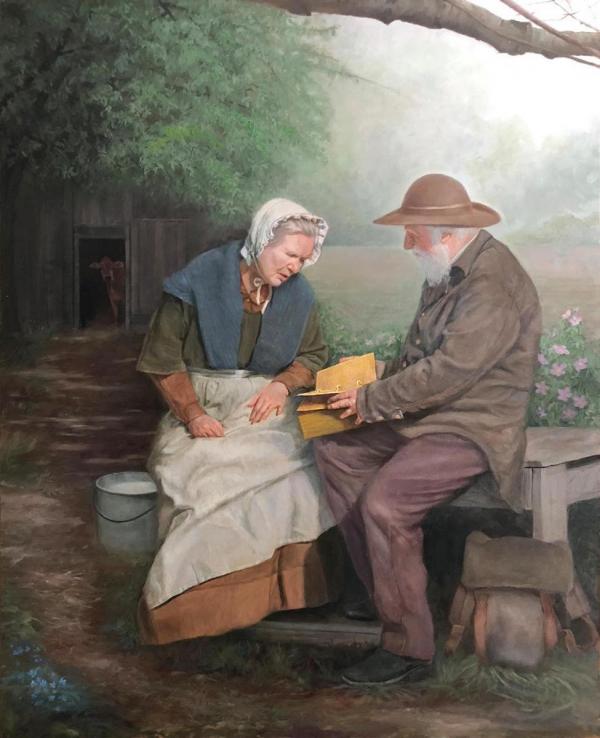
Mary Whitmer and "Moroni"
by Robert T. Pack
Editor 3: Exactly. That story has been banned by the Correlation Department. Jack censored it from Opening the Heavens and replaced it with the narrative that it was Moroni who carried the plates directly from Harmony to Fayette. The Church films on Harmony and Fayette censored the story.

Editor 2 (the mole): The films being shown in the Visitors Centers?

Editor 1: Yes. Book of Mormon Central even commissioned a painting to cement Jack's narrative about Moroni by imprinting it on the minds of Church members.

Editor 3: We have to play along.

Editor 2 (the mole): Wait a minute. You're saying we're going to deliberately insert a false story into Saints just to accommodate the M2C scholars?

Editor 1: We've been doing it all along. Why are you objecting now?

Editor 2 (the mole): Censoring the New York Cumorah is one thing, but using a false story is a step too far.

Editor 3: It's not a big deal. Look. It's mostly true. More importantly, the Correlation Department will never approve the actual history because of M2C, so why try?

Editor 2 (the mole): Maybe we should let the Brethren decide. Present them with the true account and the false one and let them...

Editor 3: Absolutely not. They've hired us to guide the Church about these things. They don't have time to micromanage this project.

Editor 1: Okay, done deal. We go with the phony Moroni story. Next issue?

Editor 2 (the mole), thinking: We'll see about this.
_____

Fortunately for Latter-day Saints everywhere, the mole took matters into his/her own hands.

This is a thing of beauty worth checking out.

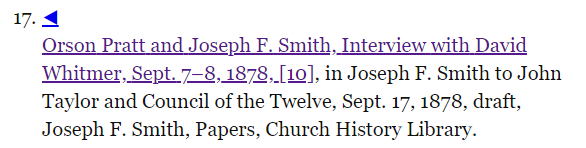
Go to Saints. Look at footnote 17 in Chapter 7.  Here it is in context:

Saints, Chapter 7, Kindle version
Saints, note 17

If you're reading an electronic version of Saints, click on the link. If you're reading a print version, you can click the link here:

https://dcms.lds.org/delivery/DeliveryManagerServlet?dps_pid=IE159944&page=44

It goes to this page in the Church History Library:

Here's where the mole did everyone in the world an enormous favor.

At first, you might think, why did they link to a handwritten document that is difficult to read? Certainly non-English speakers will get nothing out of this.

Plus, it's in cursive. Many young people can't read cursive.

This link is opaque to both groups. There are printed versions of this same account that are easy to read and translate, but Saints did not link to them.

At first, I thought this was an effort to obscure the original source. Or maybe it was just a mistaken link.

But now I think it's the work of the mole.

Here's why.

The image here is #44.

This page has nothing to do with the paragraph that cites it!

The actual page of the original document that relates to the paragraph about Mary and her hard work is image #46.

So why do we get a link to image #44?

I think the mole linked to image #44 so people could read the entire account.

IOW, people who go to the link start reading image #44 and realize there's nothing there about Mary Whitmer. Naturally, they keep reading.

When they read image #45, they get the actual history that the editors of Saints censored.

I also think the mole didn't link to a printed version because then his/her work would be too obvious. Whoever did the copy editing probably clicked on the link, saw it was a handwritten document, and figured it was all good. No need to read it to make sure it actually related to the paragraph that cited it.

The mole counted on this.
_____

Below is the printed version of the handwritten document. The excerpt starts at the bottom of image #44 (the link from note 17) and ends with the top of image #47.

You see that image # 46 is the one Note 17 should link to, based on the content of the paragraph in Saints. But instead, the mole linked to #44 so careful readers will discover what is on image #45. 

When you read this, you see why the M2C intellectuals have worked so hard to censor this account. They don't want people to know about the New York Cumorah or the two sets of plates, and the editors of Saints are collaborating with them to make sure no one learns about this.

Also, notice how David's description of the messenger contradicts the description of Moroni that we have from Joseph and Oliver.

Plus, be sure to read at the end of this post how Joseph identified the messenger as one of the Nephites. Mary Whitmer herself said the messenger identified himself as "Brother Nephi." The Three Nephites were among the 12 disciples that Christ chose, one of whom was named Nephi.

Mary was telling the truth. Saints is not.

We can all be grateful to the mole!
_____

Printed version:*

[Bottom of image #44]
When I was returning to Fayette with Joseph and Oliver, all of us riding in the wagon, Oliver and I on an old fashioned 
[image #45]
wooden spring seat and Joseph behind us, we were suddenly approached by a very pleasant, nice looking old man in a clear open place, who saluted us with 'Good morning, it is very warm,' at the same instant wiping his face or forehead with his hand. We returned the salutation and by a sign from Joseph I invited him to ride if he was going our way, but he said very pleasantly, 'No, I am going to Cumorah.' This was something new to me, I did not know what Cumorah meant, and as I looked enquiringly at Joseph, the old man instantly disappeared so that I did not see him again." 

Joseph F. Smith: "Did you notice his appearance?" 

David Whitmer: "I should think I did. He was, I should think, about 5 feet 9 or 10 inches and heavy set, about such a man as James Vancleave, there, but heavier. His face was as large. He was dressed in a suit of brown, woolen clothes; his hair and beard were white, about like Brother Pratt's, but his beard was not so heavy. I also remember that he had a sort of knapsack on his back, and something was in it which was shaped like a book. It was the messenger who had the plates. 

    "Soon after our arrival home, 
[image #46, the one note 17 should have linked to]
I saw something which led me to the belief that the plates were placed or concealed in my father's barn. I frankly asked Joseph if my supposition was right, and he told me it was. 

"Sometime after this my mother was going to milk the cows when she was met out near the barn by this same old man, (as I suppose from her description of him) who said to her `you have been very faithful and diligent in your labours but you are tried because of the increase of your toil, it is proper therefore that you should receive a witness, that your faith may be strengthened' and thereupon he showed her the plates. My Father and Mother had a large family of their own. The addition to it therefore of Joseph, Emma and Oliver very greatly increased the toil and anxiety of my mother and altho she had never complained she had sometimes felt that her labor was too much or at least she was beginning to feel so. This circumstance however completely removed all such feelings and nerved her up for her increased responsibilities." 

Orson Pratt: "Have you any idea when the records will be brought forth?" 

David Whitmer: "When we see things in the Spirit and by the power of God they seem to be right here present. The signs of the times indicate the near approach of the coming forth of the other plates, but when it will be, I cannot tell. 

[image #47]
The Three Nephites are at work among the lost tribes and elsewhere. John the Revelator is at work, and I believe the time will come suddenly, before we are prepared for it." 
_____

David Whitmer related this account several times, as I've discussed before on this blog. On one occasion, he was interviewed by Edward Stevenson.

I obtained a copy of Stevenson's journal and here's what his entry says:
Page from Stevenson journal
"I wish to mention an Item of conversation with David Whitmer in regard to Seeing one of the Nephites, Zina Young, Desired me to ask about it. David Said, Oliver, & The Prophet, & I were riding in a wagon, & an aged man about 5 feet 10, heavey Set & on his back, an old fashioned Armey knapsack Straped over his Shoulders & Something Square in it, & he walked alongside of the Wagon & Wiped the Sweat off his face, Smileing very Pleasant David asked him to ride and he replied I am going across to the hill Cumorah. Soon after they Passed they felt Strangeley and Stoped, but could see nothing of him all around was clean and they asked the Lord about it. He Said that the Prophet Looked as White as a Sheet & Said that it was one of the Nephites & that he had the plates."**

________________________________

Edward Stevenson was a general authority (one of the seven presidents of the Seventy). He was a well-known missionary (one of the MTC buildings is named after him). There's no reason to doubt the credibility of his interview with David Whitmer.

What I find fascinating is that Zina Young asked Stevenson to ask David Whitmer about seeing one of the Nephites. That was the focus of the interview, not the Cumorah question.


_____
* You can google a phrase from the account and find lots of printed versions. One I like is here:
http://www.sidneyrigdon.com/dbroadhu/ut/utahmisc.htm
Just go to the page and in your browser, search for "suddenly approached."

**You can find printed versions of this account in these references, although not transcribed exactly: "Edward Stevenson Interview (1) 22-23 December 1877, Richmond, Missouri Diary of Edward Stevenson," LDS Church Archives, Lyndon W. Cook, ed., David Whitmer Interviews, 1993, p. 13; also Dan Vogel, ed., Early Mormon Documents, 2003, vol. v, p. 30.

Tuesday, September 11, 2018

Why Saints censors key history

I'm very enthusiastic about the renewed emphasis on Church history. Everyone is reading Saints, which is awesome.

But there is another aspect of the tragedy of Saints to consider.

Because the book censors all references to the New York Cumorah, it reinforces skepticism about Church history.

Think about this: a book titled "The Standard of Truth" deliberately censors a key teaching of the founding prophets, their contemporaries and their successors.

Fortunately, there is still plenty of time to correct this censorship in the digital editions, but that correction will not happen as long as M2C* prevails.

Imagine how much more powerful the book Saints would be if it educated the Latter-day Saints about these historical facts instead of censoring them.
_____

Remember that the top two reasons Millennials give for leaving the Church are

- “I felt judged or misunderstood.”
- [tied for first] “I did not trust the Church leadership to tell the truth surrounding controversial or historical issues.”

https://religionnews.com/2017/01/27/do-mormons-leave-the-church-because-they-got-offended/


Saints is making the problem even worse by reinforcing the perception that the Church doesn't tell the truth about its history.

As a result of the pervasive censorship about the New York Cumorah, critics of the Church know more about this problem than most members do. E.g., http://www.utlm.org/onlineresources/cumorah.htm

Imagine what the youth of the Church (and investigators) think when they learn the truth about the New York Cumorah from critics instead of their CES/BYU teachers (and the missionaries).
_____

Thanks to our M2C intellectuals, we have Visitors Centers, Institute and Seminary manuals, BYU/CES, and the Church History Department all teaching that Cumorah cannot be in New York. Instead, they tell people that there are "two Cumorahs." They say the "real Cumorah" is in Mexico, while the "hill in New York" was falsely named Cumorah by early Church members, thereby creating a false tradition that Joseph Smith passively adopted.

And now Saints solidifies M2C by censoring all references to the New York Cumorah.


The M2C promoters don't even tell students that the prophets and apostles have taught the New York Cumorah consistently for 180 years, including in General Conference. When a student finds out and asks about it, their BYU/CES teachers claim the prophets and apostles were wrong.

It's a double-whammy.

First, through their censorship of Letter VII and the New York Cumorah generally, the M2C intellectuals (and Saints) don't tell the truth about what prior Church leaders have taught, thereby reinforcing the main reason why Millennials leave the Church.

Second, the M2C intellectuals claim the prophets and apostles are wrong, which, if true, leads people to wonder why we have prophets and apostles in the first place. What can possibly be more destructive to faith than having BYU/CES teachers telling students the prophets and apostles are wrong?

_____

Here is a table of examples of censorship in the first volume of Saints. There are more examples, and there will be more in the next three volumes, but this gives you an idea of the magnitude of the problem.

Event
Treatment in Saints
Justification by M2C intellectuals
During his first visit to Joseph, Moroni “proceeded and gave a general account of the promises made to the fathers, and also gave a history of the aborigenes of this country… He said this history was written and deposited not far from that place” [meaning Joseph’s home].


Censored. 

Saints changed all references to “this country” and “this continent” to the generic term “the Americas” to accommodate M2C. 

None of the original documents used the term “the Americas” in connection with the Book of Mormon.
Oliver and Joseph were wrong. 

They either didn’t quote Moroni correctly, or when Moroni said “this country” he really meant Mesoamerica. 

Also, Moroni didn’t mean the record was written not far from Joseph’s home; it was actually written in Mesoamerica.
Moroni told Joseph the hill was named Cumorah even before Joseph got the plates.

Lucy Mack Smith described an event that occurred when Joseph was returning from Manchester in 1827, before he got the plates. He was late coming home, and his parents questioned him about where he was. He explained he’d had a sever chastisement and his father became angry, wanting to know who had harassed Joseph. Lucy reported Joseph’s response in a direct quotation.

“Stop, father, Stop.” said Joseph, “it was the angel of the Lord— as I passed by the hill of Cumorah, where the plates are, the angel of the Lord met me and said, that I had not been engaged enough in the work of the Lord…”
Censored.

Note: In the Joseph Smith Papers, this passage isn’t even indexed under “Cumorah” so readers can’t find it when they search for Cumorah.
Lucy Mack Smith was wrong. 

She must have been confused, or she conflated her account with the false tradition about the New York Cumorah started by Oliver Cowdery or someone else.
When David Whitmer was taking Joseph Smith and Oliver Cowdery from Harmony, PA, to Fayette, NY, he met a divine messenger who said he was taking the plates to Cumorah.

During the interview, Whitmer said he, Oliver and Joseph were riding in a wagon on the way to Fayette when a man appeared next to the wagon. "I invited him to ride if he was going our way. But he said very pleasantly, “No, I am going to Cumorah.’ This name was something new to me, I did not know what Cumorah meant. We all gazed at him and at each other, and as I looked round enquiringly of Joseph the old man instantly disappeared, so that I did not see him again....It was the messenger who had the plates, who had taken them from Joseph just prior to our starting from Harmony."

Millennial Star (Vol. 40, No. 49, Dec. 9, 1878, p. 769, online here, scroll down to Dec. 9 and open the first file) titled “Report of Elders Orson Pratt and Joseph F. Smith.”


another example of censorship of this account is here:
Censored.

This account was also censored in the recent Church films about Harmony and Fayette. 

It was also censored and even changed in the book Opening the Heavens, edited by brother John W. Welch, who is also Editor-in-Chief of BYU Studies and Chairman of Book of Mormon Central.


David Whitmer was wrong. 

Although he repeated this account multiple times with a lot of detail, David was either mistaken, confused, or conflated this account with the false tradition about the New York Cumorah.

This account was given in a formal and public report to the Quorum of the Twelve by two Apostles, but Church members today should not ever be told about it.
During the mission to the Lamanites, Oliver Cowdery explained that it was Moroni who named the hill in New York Cumorah.

"This Book, which contained these things, was hid in the earth by Moroni, in a hill called by him, Cumorah, which hill is now in the State of New York, near the village of Palmyra, in Ontario county."

Autobiography of Parley P. Pratt, p. 57
_____
By the way, Saints doesn't even quote the revelations that called Oliver, Parley and others (D&C 28, 30, 32) on the mission to the Lamanites. Instead, Saints substitutes "American Indians" for "Lamanites" in this passage: "The revelation then called Oliver to go nearly a thousand miles to the western edge of the United States to preach the restored gospel to American Indians, who were remnants of the house of Israel.... The Lord called Peter Whitmer, Jr., Ziba Peterson, and Parley Pratt to join Oliver on the mission to the west." 

The Joseph Smith Papers goes so far as to use quotation marks to distance the intellectuals from the revelations: The link between the Book of Mormon peoples and the American Indians appears in connection with the mission of Oliver Cowdery and others to preach to the “Lamanites” in 1830–1831."

Censored.


Parley P. Pratt was wrong. 

He either mis-remembered when he wrote his journal, or he was repeating the false tradition.

Speaking of the mission to the Lamanites, notice how Saints and the Joseph Smith Papers change the terminology of the revelations to American Indians instead of Lamanites. 

Why this change? The American Indians are genetically distinct from the Mayans, so the revelations contradict M2C.

President Cowdery explained it was a fact that the Hill Cumorah in New York is the same one Mormon described in Mormon 6:6. This account was published in the Messenger and Advocate, the Millennial Star, the Times and Seasons, the Prophet and the Gospel Reflector. Joseph had his scribes copy it into his own history, where we can read it today in the Joseph Smith Papers.

“At about one mile west rises another ridge of less height, running parallel with the former, leaving a beautiful vale between. The soil is of the first quality for the country, and under a state of cultivation, which gives a prospect at once imposing, when one reflects on the fact, that here, between these hills, the entire power and national strength of both the Jaredites and Nephites were destroyed....

[Mormon], by divine appointment, abridged from those records, in his own style and language, a short account of the more important and prominent items, from the days of Lehi to his own time, after which he deposited, as he says, on the 529th page, all the records in this same hill, Cumorah and after gave his small record to his son Moroni, who, as appears from the same, finished, after witnessing the extinction of his people as a nation.

This hill, by the Jaredites, was called Ramah: by it, or around it pitched the famous army of Coriantumr their tents.

In this same spot, in full view from the top of this same hill, one may gaze with astonishment upon the ground which was twice covered with the dead and dying of our fellow men. Here may be seen where once sunk to nought the pride and strength of two mighty nations; and here may be contemplated, in solitude, while nothing but the faithful record of Mormon and Moroni is now extant to inform us of the fact...

In this vale lie commingled, in one mass of ruin the ashes of thousands, and in this vale was destined to consume the fair forms and vigerous systems of tens of thousands of the human race—blood mixed with blood, flesh with flesh, bones with bones and dust with dust!”


 Censored.
President Cowdery was wrong. He was elaborating on the false tradition.

Joseph Smith was wrong when he passively adopted this false tradition when he made sure this account was republished throughout the Church while he was alive.

Every apostle and prophet who has taught this was wrong.

No prophet or apostle has ever questioned or repudiated his predecessors’ teaching about the New York Cumorah.

Only the M2C intellectuals, who have been hired to guide the Church, know the truth; i.e., that the real Cumorah is in Mesoamerica.


_____
* M2C is the Mesoamerican/two-Cumorahs theory.


Monday, September 10, 2018

M2C web part 8 - new development

I'm suspending my series on the M2C web because I've stumbled upon a treasure trove of original material that, as far as I can tell, has never been digitized and indexed. I have to go through it manually. I think you'll find it fascinating and highly relevant to the translation issues and Early Modern English.

The material doesn't appear in the Joseph Smith papers. It's not in my usual sources (Dan Vogel, Dale Broadhurst (http://olivercowdery.com/, centerplace.org, the M2C citation cartel, etc).

This all started as a chapter in my next book. I was writing about the Early Modern English fad, along with the translation generally. Now there is so much material that I can only summarize it in the book, but I'll probably write a separate more detailed book for people who like references.

I'm going to present it for the first time publicly at the Book of Mormon Evidence Conference in Sandy, Utah, on Sept. 28-9.

I hope to see you at the conference.

Title Page, Part One of Volume 3
BTW, the timing is perfect. It's just a few days after the BYU Studies event in Provo on Sept. 25. This is the one where Brothers Skousen and Carmack are introducing their new book the Critical Text series. I'll discuss that at the conference on the 28th and 29th.

I hope everyone is familiar with the Critical Text project. It is phenomenal. I refer to it all the time. My only problem with it is the Early Modern English theory, as we've been discussing.

Here's the main web page: http://criticaltext.byustudies.byu.edu/

I've gone through most of these books in detail, including Parts 1 and 2 of Volume 3. Part 3 of Volume 3 is the book they are going to be discussing on September 25.

Maybe they'll address the points I've discussed in this series on the M2C web and EME-OT. Maybe they'll address the new material I'm working on right now.

I hope they do, but I doubt they will.
_____

My other talk at the conference is on Saints, the new Church history book. It's going to be epic.

:)
_____

M2C web part 7 - EME-OT and 2 Nephi 27

People are asking me why I am commenting on the Early Modern English theory. After all, Brothers Skousen and Carmack are experts in these areas.

making assumptions about Joseph's dialectal usage
I repeat that I greatly admire and respect them and their work, overall. I just think they've made a major mistake on the Earty Modern English issue.

Here's a passage from p. 13 of Part One of Volume 3 that explains their position that I disagree with.

It reads:

In quite a few cases, the Book of Mormon usage is restricted to Early Modern English and died out by the 1700s. One surprising finding is that nearly all the Book of Mormon usage that many have thought to be simply Joseph Smith's Upstate New York dialect has actually been identified as Early Modern English. In other words, the original Book of Mormon text is archaic English (dating from Early Modern English) rather than Joseph Smith's dialectical English.

[I don't think anyone can say what Joseph Smith's dialectal English was apart from the text of the Book of Mormon, because we don't have an electronic recording of it. Brothers Skousen and Carmack assume Joseph's dialect can be reconstructed from his brief writings, but no one speaks the way they write, as I've discussed before. Certainly we can't discern a particular dialect from examining ngrams of published works.]

This important finding will be thoroughly discussed in part 3 of volume 3 of the critical text. There Stanford Carmack and I will consider virtually all the strange words, phrases, and syntax from the original Book of Mormon text, most of which have never been edited out of the text but which fit best as examples of Early Modern English usage rather than Joseph Smith's dialectal usage from the early 1800s.

Well, we'll see.

:)
_____

BTW, Here are two specific points you might find interesting.

One of the rationales for the revisionist history that has Joseph simply reading the English words off the seer stone instead of translating is an interpretation of certain passages from 2 Nephi 27, as Brother Carmack lists them in Part 1 of Volume 3:
 
11- the words of the book ... shall be read by the power of Christ
19 - the Lord God will deliver again the book and the words thereof to him that is not learned
20 - wherefore thou shalt read the words which I shall give unto thee
22 - when thou has read the words which I have commanded thee
24 - the Lord shall say unto him that shall read the words that shall be delivered him

I can see how some people interpret these passages to mean Joseph was merely reading the words on the seer stone; i.e., that he didn't actually translate the Nephite records, but simply read the translation that had been accomplished by someone else who, inexplicably, used Early Modern English. This is what I call the EME-OT theory; i.e., the Early Modern English-Other Translator theory. 

However, that strikes me as an implausible interpretation for all the reasons I've been discussing, as well as the reasons I'll explain at the conference on Sept 28-9.

In the meantime, I wanted to address this specific theory about reading the words. Here are the verses from 2 Nephi 27, with my commentary:

5 For behold, the Lord hath poured out upon you the spirit of deep sleep. For behold, ye have closed your eyes, and ye have rejected the prophets; and your rulers, and the seers hath he covered because of your iniquity.

[When the M2C intellectuals tell me (and others) that they don't care what the "dead prophets" have said about the New York Cumorah because the current prophets and apostles haven't specifically reaffirmed the New York Cumorah (the last time an apostle taught it in General Conference was 1978, 40 years ago), I think of this passage. 

Here Nephi tells us that when we reject the prophets, the Lord covers the seers. Beginning around 1978, LDS intellectuals began specifically and overtly rejecting the prophets' teachings about the Hill Cumorah, and most Church members since then have gone along with them thanks to the Academic Cycle and the M2C employees at CES. BYU and COB. According to verse 5, we should therefore expect the seers to be "covered" on this topic.]

6 And it shall come to pass that the Lord God shall bring forth unto you the words of a book, and they shall be the words of them which have slumbered.

[Notice here that Nephi does not say "shall bring forth unto you the words of this book." This is additional evidence of the two sets of plates; i.e., that the plates of Nephi (D&C 10), which we call the small plates, were not part of the set of plates Moroni put in his stone box on the hill Cumorah. Joseph never had the plates of Nephi when he was in Harmony. Had Martin Harris not lost the 116 pages, Joseph would never have received the plates of Nephi in Fayette. Today we would have had what Joseph called "the Original Book of Mormon," not the combination of part of the abridgment plus the plates of Nephi which we have instead.

Speaking of D&C 10, notice how in verse 45 the Lord told Joseph "it is wisdom in me that you should translate this first part of the engravings of Nephi, and send forth in this work." The reference to "this work" relates back to D&C 9:1, when the Lord told Oliver to continue "until you have finished this record," meaning the plates Joseph got from Moroni's stone box. Once they finished those plates, the Harmony plates, there would be "other records" to translate; i.e., the plates of Nephi they didn't have yet (and didn't even know about until Joseph received D&C 10). 

Notice also that the Lord told Joseph to "translate" the "engravings of Nephi." He didn't say read someone else's translation. He didn't say "just leave the plates under a cloth, because you don't need them." He told Joseph to translate the engravings. 

7 And behold the book shall be sealed; and in the book shall be a revelation from God, from the beginning of the world to the ending thereof.

Again, this is not the book Nephi was writing; it did not include 2 Nephi 27. This book is yet to come forth, of course.

8 Wherefore, because of the things which are sealed up, the things which are sealed shall not be delivered in the day of the wickedness and abominations of the people. Wherefore the book shall be kept from them.

We still live in the day of wickedness and abominations, so the book is kept from us.

9 But the book shall be delivered unto a man, and he shall deliver the words of the book, which are the words of those who have slumbered in the dust, and he shall deliver these words unto another;

The physical book was delivered to Joseph by Moroni. Joseph then delivered the words of the book to Oliver Cowdery (meaning, he translated the words and dictated them). 

10 But the words which are sealed he shall not deliver, neither shall he deliver the book. For the book shall be sealed by the power of God, and the revelation which was sealed shall be kept in the book until the own due time of the Lord, that they may come forth; for behold, they reveal all things from the foundation of the world unto the end thereof.

Joseph never delivered the book; i.e., he never gave over the plates, except to the witnesses. 

11 And the day cometh that the words of the book which were sealed shall be read upon the house tops; and they shall be read by the power of Christ; and all things shall be revealed unto the children of men which ever have been among the children of men, and which ever will be even unto the end of the earth.

This is yet future, but certain.

12 Wherefore, at that day when the book shall be delivered unto the man of whom I have spoken, the book shall be hid from the eyes of the world, that the eyes of none shall behold it save it be that three witnesses shall behold it, by the power of God, besides him to whom the book shall be delivered; and they shall testify to the truth of the book and the things therein.

Here are the 2 witnesses.

13 And there is none other which shall view it, save it be a few according to the will of God, to bear testimony of his word unto the children of men; for the Lord God hath said that the words of the faithful should speak as if it were from the dead.

This deserves a little comment. This has always seemed a little strange; why would verse 12 specify three witnesses, only to have verse 13 say "a few" would also view it? Usually we interpret this to mean the eight witnesses, but I think they more likely handled the plates of Nephi instead of the Harmony plates (the abridged plates), for all the reasons I've explained. But there were "a few" others who saw the Harmony plates, including Josiah Stowell and Mary Whitmer. They did bear testimony of the word. Alternatively, maybe the eight witnesses would have handled the Harmony plates, including the sealed portion, had Martin Harris not lost the 116 pages, in which case Joseph would not have needed the plates of Nephi.

14 Wherefore, the Lord God will proceed to bring forth the words of the book; and in the mouth of as many witnesses as seemeth him good will he establish his word; and wo be unto him that rejecteth the word of God!

15 But behold, it shall come to pass that the Lord God shall say unto him to whom he shall deliver the book: Take these words which are not sealed and deliver them to another, that he may show them unto the learned, saying: Read this, I pray thee. And the learned shall say: Bring hither the book, and I will read them.

Notice, the Lord did not tell Joseph to take the words on the seer stone; instead, he told him to take the words of the engravings, which is what Joseph gave Martin to take to New York. Obviously, had these "words" consisted of an Early Modern English translation, the professors in New York could have read them. 

BTW, some people think Joseph didn't know about this prophecy until after Martin Harris returned from New York, but President Cowdery's letters explain that Moroni told Joseph about this prophecy the first night he visited him. 

16 And now, because of the glory of the world and to get gain will they say this, and not for the glory of God.

17 And the man shall say: I cannot bring the book, for it is sealed.

18 Then shall the learned say: I cannot read it.

Anthon couldn't read the engravings, but he could have read Early Modern English if that was what Martin Harris had taken him; i.e., if the term "words" in verse 15 means EME. 

19 Wherefore it shall come to pass, that the Lord God will deliver again the book and the words thereof to him that is not learned; and the man that is not learned shall say: I am not learned.

This is Joseph saying he's not learned. It's not clear what it means by "deliver again," because we don't have a record of Joseph giving up the book when Martin Harris left for New York.

20 Then shall the Lord God say unto him: The learned shall not read them, for they have rejected them, and I am able to do mine own work; wherefore thou shalt read the words which I shall give unto thee.

Joseph has to read the words that the learned could not read; i.e., the engravings. Here, though, the passage could also refer to the words the Lord would "give" Joseph through the Urim and Thummim.

21 Touch not the things which are sealed, for I will bring them forth in mine own due time; for I will show unto the children of men that I am able to do mine own work.

We don't know exactly how they were sealed, but apparently they were not sealed in a matter that prevented Joseph from getting into them if he wanted to, so the Lord had to tell him not to touch them. Of course, all of this is inconsistent with the now-popular opinion that Joseph never used the plates.

22 Wherefore, when thou hast read the words which I have commanded thee, and obtained the witnesses which I have promised unto thee, then shalt thou seal up the book again, and hide it up unto me, that I may preserve the words which thou hast not read, until I shall see fit in mine own wisdom to reveal all things unto the children of men.

Brigham Young explained that Joseph returned the plates to the depository in the Hill Cumorah, which is consistent with this passage. Those would have been the plates Joseph showed to the Eight Witnesses; i.e., the original plates of Nephi. Joseph also explained in JS-H 1:60 that he gave the plates to the messenger "according to arrangements." Those would have been the Harmony plates he gave to the messenger before leaving Harmony.  

23 For behold, I am God; and I am a God of miracles; and I will show unto the world that I am the same yesterday, today, and forever; and I work not among the children of men save it be according to their faith.

Once we have the faith to accept the teachings of the prophets and of the Book of Mormon, we will get the rest of the plates.

24 And again it shall come to pass that the Lord shall say unto him that shall read the words that shall be delivered him:

This is consistent with Joseph reading the engravings that were delivered to him. 

25 Forasmuch as this people draw near unto me with their mouth, and with their lips do honor me, but have removed their hearts far from me, and their fear towards me is taught by the precepts of men

26 Therefore, I will proceed to do a marvelous work among this people, yea, a marvelous work and a wonder, for the wisdom of their wise and learned shall perish, and the understanding of their prudent shall be hid.

The conflict between the prophets and the intellectuals will be resolved in favor of the prophets. Including on the issue of the New York Cumorah.

_____

Wednesday, September 5, 2018

A Mole at the Ensign?


Ensign, Sept. 2018
The September Ensign/Liahona includes an awesome article on the last page titled "Led by Living Prophets."

Everyone should read it.

We have to wonder if there's a mole working at the Ensign to persuade members of the Church--including the M2C intellectuals--to follow the prophets.

A few more articles such as this and we might end up with more members of the Church aligning with the prophets instead of the intellectuals.

Next, we hope the mole somehow gets Letter VII republished in the Ensign/Liahona, the way it was republished in the Times and Seasons, the Gospel Reflector, the Millennial Star, The Prophet, and The Improvement Era. It is also in the Joseph Smith Papers, but hardly anyone knows it.

http://www.josephsmithpapers.org/paper-summary/history-1834-1836/90
_____

Ensign, Jan. 1973
The current Ensign/Liahona article is an excerpt from a talk given by Elder Mark E. Petersen in General Conference in October, 1972.

It was published in the Ensign in January, 1973.

Six years later, Elder Petersen gave a talk in General Conference titled "The Last Words of Moroni."

You can read and listen to it here:
https://www.lds.org/general-conference/1978/10/the-last-words-of-moroni?lang=eng

As we've come to expect by now, the M2C intellectuals say he was wrong. But remember that Elder Petersen was merely reaffirming the consistent and persistent teachings all of his Apostolic predecessors; i.e., that the Hill Cumorah is in New York.
_____

Here are key excerpts from the current Ensign/Liahona, along with additional excerpts from Elder Petersen's 1972 talk in blue and his 1978 talk in purple, interspersed with statements from our M2C intellectuals, all in pink.

It's one of many examples of how this issues gives us a clear choice between scholars and prophets.

Which set of teachings do you believe?
_____

Always when the Lord has had a people on the earth whom He has recognized as His own, He has led them by living prophets to whom He has given guidance from heaven. …

Who can worship intelligently if kept in ignorance?

Human beings are slow to learn the ways of the Lord, and particularly are they dilatory in accepting the fact that although He is willing to communicate with them, His method of doing so is through inspired living men whom He designates as prophets.

Paul told the Ephesians that the church of Jesus Christ was built upon a foundation of apostles and prophets, with the Savior himself as the chief cornerstone. (See Eph. 2:20.)

Who were the prophets of that day?

The Twelve were included, of course. 
_____

Moroni’s father was commander of the armies of this ancient people, known as Nephites. His name was Mormon. The war of which we speak took place here in America some four hundred years after Christ. (See Morm. 6.)

As the fighting neared its end, Mormon gathered the remnant of his forces about a hill which they called Cumorah, located in what is now the western part of the state of New York.


Their enemies, known as Lamanites, came against them on this hill. 

There remain Latter-day Saints who insist that the final destruction of the Nephites took place in New York, but any such idea is manifestly absurd... a scenario worthy only of a witless sci-fi movie, not of history.
_____

Since the Savior commanded his people to become perfect as their Father in heaven (see Matt. 5:48), he set up his church to provide the means by which this could be accomplished. Hence, he gave them apostles and prophets.

When finished with the record, Moroni was to hide it up in that same Hill Cumorah which was their battlefield. It would come forth in modern times as the Book of Mormon, named after Moroni’s father, the historian who compiled it.

The Hill in New York, mistakenly named Cumorah by early Saints...

The name stuck and over the years the tradition developed that the hill was the site of the last Nephite battles.

The primary issue at stake for Latter-day Saints is how to correlate the traditional concept that the last battles were fought in New York with the newer concept that they were fought in Mexico.

These inspired men were in the church also to preserve unity among the saints and to heal divisions in the flock “that we henceforth be no more … tossed to and fro, and carried about with every wind of doctrine. …” (Eph. 4:14.)

In Isaiah’s day it was the people who turned away from God. The Lord did not turn from the people.

Since the 1950s, opinion among Book of Mormon scholars has increasingly trended toward the realization that the Nephite Cumorah and the Hill in New York cannot be the same.

It was the same in the Savior’s day. Do you recall that he said to those about him: “… how often would I have gathered thy children together, even as a hen gathereth her chickens under her wings, and ye would not!” (Matt. 23:37.)


God does not abandon his people. It is the people who abandon God.

It is true that a number of Church leaders in the past expressed the opinion that the hill in New York is the same hill described in the Book of Mormon. Statements from Joseph Smith or others on geography are not binding on the Church. 

We solemnly testify that communication between heaven and earth has been reestablished in our day. We declare that God is not isolated from the world.

He speaks, eloquently, to his living prophets and through them to the world at large.

Had not the Lord said to them, as he says to us now, that America is a choice land and that those who live here must obey God or be swept off?

In closing his record, and knowing that it would come to us, Moroni pleaded with us, the modern inhabitants of this land, to escape the kind of tragic end which had obliterated his people.

Mormon then wrote directly to us as modern Americans who now occupy this promised land and said: “How can ye stand before the power of God, except ye shall repent and turn from your evil ways?

So this is the message of Moroni. He came back from the dead to deliver it—in these modern times.

His people were Americans, too. His words constituted a people-to-people message, ancient Americans speaking to modern Americans. 


The last words of Moroni! Dare we forget them? God grant that we never will, I pray in Jesus’ name. Amen.


Monday, September 3, 2018

The Tragedy of Saints

When I first heard about the new book series titled Saints, I was enthusiastic. It was being organized and written in an interesting narrative style. There is a tremendous need for a clear, concise, accurate and well-documented source for Church history, especially among readers who don't read English.

Saints fills that need very well. I'm still enthusiastic about the book series. I support the series and encourage everyone to read it. Everyone involved with Saints has done phenomenal work and deserve our gratitude for a job well done.

But... in subtle yet unmistakable ways, and probably unintentionally in many respects, Saints pushes revisionist Church history.

I think this is a tragedy.

To help people see what has happened, I'm publishing a series of comments on Saints, coming from a faithful perspective. I'm providing the original sources and significant events readers will not find in Saints.

I'll cover each chapter, first on a blog and eventually in print and e-book. Here is the blog:

https://saintsreview.blogspot.com/
_____

You may think it's much too late to address these issues now that the books have all been translated and printed, but I haven't waited until now. I raised these issues over a year ago with people in charge of Saints, but they decided to proceed with the M2C narrative anyway.

In reality, the print versions don't matter that much. Most readers will get digital copies. Here in Africa, everyone reads e-books. That's true in India and China and most of the world, actually.

So there's hope.

Digital editions of Saints in all languages can be edited to educate readers about the teachings of the prophets and delete or edit the existing content accordingly.
_____

The book series is designed to allow people to access Church history in terms of breadth and depth, as this chart shows.

Theoretically, this design allows Church members to learn as much as they want in both directions. As such, it is a wonderful resource. I strongly support the book series and its objectives.

Fortunately, the books cite original sources.

Unfortunately, those sources are still in English.

More unfortunately, the narrative leads readers to accept a particular point of view that I call revisionist Church history. Saints omits key events, changes terminology, includes phony quotations, and obscures important elements in Church history. All of this undermines the objective of educating and inoculating members of the Church and investigators.

Because it is being heavily promoted and translated into 40+ languages, Saints will cement revisionist Church history as the standard. Readers will never learn of key events in Church history that have been the basis of prophetic teachings since the Church was organized.
_____

Even before it was published, I had concerns about Saints because many of the people involved are  within the M2C bubble. They don't realize it; they just assume M2C. And they don't seek or accept input from outside that bubble.

If you ask, most Church historians have a stock answer. They will tell you they are not in the M2C bubble because they don't have an opinion about Book of Mormon geography. They'll say they're neutral, that the issue doesn't matter, etc.

But if it didn't matter, they wouldn't have revised Church history the way they have.

In fact, they'll say they carefully avoided addressing the issue when they wrote Saints.

But as you'll see in my commentary, "carefully avoided" means "deliberately changed" the history. Saints changes wording and omits references to censor what early Church leaders said about the New York Cumorah and related issues.

I'm not reading minds; I don't care about motivations, anyway. I'm just looking at the words on the page.

Saints was written to accommodate M2C.

Think about this. To "avoid" the issue of Book of Mormon geography they had to revise and censor Church history. 

What does that tell you about the original sources?

It tells you that the original sources support and affirm the teachings of the prophets about the New York Cumorah.

People inside the M2C bubble don't want Church members to know what the prophets have taught, and they successfully wrote Saints to accomplish this, all the while pretending it's not an important issue.

That's why it's a tragedy.
_____

Church history is fascinating and faith-affirming, but many Church members don't know much more than the basics. This makes them susceptible to claims by critics that the original accounts are wrong.

Such critics come from both outside and inside the Church.

The old History of the Church was helpful, but ultimately misleading and incomplete. For example, its editors converted third-person accounts into fictitious first-person narrative by Joseph Smith.*

More recent publications favor the revisionist Church history that teaches Joseph never actually used the plates, Joseph and Oliver were wrong about the New York Cumorah, and lately that Joseph didn't actually translate the plates after all (the Early Modern English-Other Translator theory).

I disagree with the revisionist historians because I think the evidence supports what the original prophets taught. Plus, all of their successors have affirmed these teachings.

Church members are best served by the truth. Then they are immune to the critics, whether they come from outside or inside the Church. Revising Church history to accommodate M2C and other theories is not helpful.
_____

People are going to tell me that I'm wrong to criticize Saints because it has been "approved by the Brethren."

First, I fully support the Brethren in everything they do. There has been a tremendous need for an accurate Church history in multiple languages. Saints is an important, even critical project.

Second, the books were written by employees, not Church leaders. I realize that some employees like the 14th Article of Faith, but I don't think most of them do, and I don't either.

Third, Saints is not scripture. It is not the teaching of the prophets. When it contradicts the teachings of the prophets, or misleads readers about what the prophets have taught, I don't think it is above criticism.

Fourth, the Brethren necessarily and understandably trust and defer to the experts. It's not their fault when the experts mislead the Brethren or don't give them multiple points of view to consider before making decisions.

Fifth, if it turns out that the Brethren have decided to repudiate the teachings of their predecessors, then I'll support them. But I'm not going to support the intellectuals who have decided to repudiate the teachings of the prophets the way they have in Saints.
_____

Here's an example of what I'm writing about.

The series Saints has four volumes. The respective titles are passages from Joseph Smith's famous Wentworth letter, as shown below. But this is especially ironic because the Wentworth letter is one of the most notorious examples of M2C censorship.

Here's the relevant excerpt from the Wentworth letter.

Our missionaries are going forth to different nations, and in Germany, Palestine, New Holland, Australia, the East Indies, and other places, the Standard of Truth has been erected; no unhallowed hand can stop the work from progressing; persecutions may rage, mobs may combine, armies may assemble, calumny may defame, but the truth of God will go forth boldly, nobly, and independent, till it has penetrated every continent, visited every clime, swept every country, and sounded in every ear; till the purposes of God shall be accomplished, and the Great Jehovah shall say the work is done.

The Correlation Department censored a key passage from the Wentworth letter in the lesson manual, Teachings of the Presidents of the Church: Joseph Smith.

See http://www.lettervii.com/2018/07/editing-wentworth-letter.html

Regardless of any rationale behind this censorship, the result is the same as we see in the editorial decisions in Saints; i.e., people don't want members of the Church to read the teachings of the prophets about the New York Cumorah and related issues because those teachings contradict M2C.
_____

I reiterate that I love the book series. I think Saints will make a big difference for people throughout the world.

I just think it's a tragedy that for purposes unrelated to accuracy, we're getting revisionist Church history that accommodates the M2C intellectuals but leaves readers confused and disturbed in their faith in the Book of Mormon.
_____

* The most famous example of this remains in the Introduction to the Book of Mormon:

Concerning this record the Prophet Joseph Smith said: “I told the brethren that the Book of Mormon was the most correct of any book on earth, and the keystone of our religion, and a man would get nearer to God by abiding by its precepts, than by any other book.”

Joseph never said that. The statement was Wilford Woodruff's summary of what Joseph said during an entire day, and Woodruff didn't put it in quotations.