Tuesday, June 12, 2018

Fun video on US/N.Korea and two theories of BofM geography.

Parody of the North Korea video, adapted to M2C:

https://www.youtube.com/watch?v=AhLJEmqgSKE&feature=youtu.be


New Twitter account

I have a new twitter account.

https://twitter.com/PresidentCowde1

If you use twitter, be sure to follow this account because I'll be tweeting there more than I have time to blog here.

Monday, June 11, 2018

June 2018 Ensign - Unity, but why is Church History Department misleading the Saints about Cumorah?

The June 2018 Ensign has a wonderful short article titled "United in Doing Good."  It fits well with the "summer of love theme."

The article includes excerpts from Lucy Mack Smith, History, 1845, and the Nauvoo Relief Society Minute Book, including Emma Smith's observation about "the necessity of being united among ourselves." The article notes that "President E. Smith … rose and said that measures to promote union in this society must be carefully attended to."

The summer of love is an ideal time to contemplate unity. Church members seek complete unity and harmony as we minister to one another and to the world at large.

But, as Emma also said, we need to "deal frankly with each other."

And, frankly, there is an ongoing obstacle to unity in the Church, found right in this Ensign.

It concerns the Book of Mormon, and the ongoing efforts by the Church History Department (CHD) to revise Church history to promote M2C.* CHD appears to be colluding with the efforts of BYU/CES to teach the Saints that the prophets are wrong about the New York Cumorah.

This is part of a pattern of conduct, enforced by the Correlation Department, to censor references in Church history that contradict the prevailing M2C narrative. We've seen it in lesson manuals (e.g., here, where they edited the Wentworth letter), artwork, media, and visitors centers. 

Now we have the Ensign itself censoring a key reference to the hill Cumorah in New York.

How can we achieve unity when employees at BYU/CES/COB are teaching the youth, and the world at large, that the prophets are wrong?
_____

The same June 2018 Ensign that contains Emma's comments about unity also contains a chapter from the new Church history book Saints that misleads the Saints about an important event in the life of Joseph Smith.

Much of what we discuss on this blog can be chalked up to ignorance about what the prophets have taught, which is understandable because LDS intellectuals have done everything possible to suppress Letter VII and the teachings of the prophets about the New York Cumorah.

But today we're going to look at what appears to be a deliberate effort by the Church History Department to mislead members of the Church by (i) inaccurately paraphrasing an important account in Church history and (ii) omitting critical information from that account.

NOTE: new readers who are not familiar with the M2C academic cycle that has caused this problem can read the background in the last section of this post.
_____

Now, we ask, how is the Church History Department misleading the Saints about Cumorah, and why are they doing it?

One would think the Church History Department would be neutral on the topic of Book of Mormon geography, but the employees there are close colleagues of the M2C promoters at BYU/CES and they are doing what they can to enable their colleagues to promote M2C.

I showed an example from the April Ensign, but the June Ensign is the most egregious (so far).

The June Ensign includes chapter 4 from Saints, the revisionist Church history book being published by the Church Historian's Office. You can read Chapter 4 here: 


To be sure, Saints is being written to appeal to a broad audience. It takes liberties with quotations and paraphrasing. But that's not an excuse to mislead the Saints by omitting important information merely because it contradicts M2C.

This chapter, titled "Be Watchful," covers the events leading up to the time when Joseph obtained the plates. At one point, the chapter relates an account of Joseph being chastised.

Here's the quotation:


One day, Joseph went to town on an errand. Expecting him back for dinner, his parents were alarmed when he did not return. They waited for hours, unable to sleep. At last Joseph opened the door and threw himself into a chair, exhausted.
Lucy Mack Smith, History, 1844-5
the part quoted and cited in Saints is lined out

“Why are you so late?” his father asked.

“I have had the severest chastisement that I ever had in my life,” Joseph said.

“Who has been taking you to task?” demanded his father.

“It was the angel of the Lord,” Joseph replied. “He says I have been negligent.” The day of his next meeting with Moroni was coming soon. “I must be up and doing,” he said. “I must set myself about the things which God has commanded me to do.”19


This is Lucy Mack Smith's history from 1844-5. If you go to the link, you'll see that the quoted section is lined out.

You wonder, why would the Church History Department misquote and cite a source that was lined out in the original?

What makes this inexcusable is that Lucy revised this particular section. That's why it is lined out here. But the Church History Department avoids the revision because it refutes M2C.

The notes to Lucy's History explain that this 1844 version was a rough draft:

Note: 


, the mother of Joseph Smith, dictated a rough draft version of her history to Martha Jane Knowlton Coray (with some additional scribal help from Martha’s husband, ) beginning in 1844 and concluding in 1845. In 1845, the Corays inscribed this fair copy of the history under Lucy’s direction. 

Notice, the passage quoted in Saints was lined out because Lucy revised it in the 1845 version. 

The Church History Department is not unaware of the 1845 version. In fact, the article titled "United in Doing Good" about Emma Smith (the one we looked at in the first part of this post) cites the 1845 version.

Naturally, you wonder, why doesn't the Church History Department cite the revised version, the one in which Lucy corrected the early draft?

Because of M2C. 

Notice how Lucy revised the lined out passage. 

She provides more details and instead of having Moroni tell Joseph he is "negligent," she quotes Joseph as saying the angel told him he "had not been engaged enough in the work of the Lord." 

Significantly, she also quotes him saying this happened "as I passed by the hill of Cumorah, where the plates are." 

The basic premise for M2C is that the "hill in New York" was not really Cumorah. Instead, the M2C intellectuals claim, the hill in New York was mistakenly labeled Cumorah by early Saints, and Joseph passively adopted this false tradition, thereby misleading the Saints. All the prophets who have affirmed the New York Cumorah were also wrong, according to these intellectuals.

But here, Lucy recalled that Joseph referred to Cumorah, by name, before he even obtained the plates. He could only have learned this from Moroni.

Here is the later, corrected version from 1845:

Lucy Mack Smith, History, 1845
The revision that quotes Joseph referring to
Cumorah before he even got the plates is not
mentioned, quoted or cited in Saints.
Presently he smiled, and said in a very calm tone, “I have taken the severest chastisement, that I have ever had in my life”. 

My husband, supposing it was from some of the neighbors, was quite angry; and observed, “I would would like to know what business any body has to find fault with you.”

“Stop, father, Stop.” said Joseph, “it was the angel of the Lord— as I passed by the hill of Cumorah, where the plates are, the angel of the Lord met me and said, that I had not been engaged enough in the work of the Lord; that the time had come for the record to <​be​> brought forth; and, that I must be up and doing, and set myself about the things which God had commanded me to do: but, Father,’ continued he, ‘give yourself no uneasiness concerning the reprimand that I have received; for I now know the course that I am to pursue; so all will be well.”


This statement about Cumorah completely supports the teachings of the prophets and refutes the teachings of the M2C intellectuals.

Pause a moment and realize what a difference it would make if the Church History Department was honest and accurate. The book Saints would include the statement from Lucy's revised history. Everyone in the Church (as well as investigators) would learn that Joseph learned the name Cumorah before he even obtained the plates. The translation was yet in the future. Joseph could only have learned the name of the hill from Moroni.

Obviously, if that was the case, then the hill in New York is actually Cumorah, as the prophets have consistently and persistently taught.

But the Church History Department doesn't want members of the Church to even know about this, so instead they cite (and quote) a rough draft that was lined out and replaced with a more detailed and corrected version of the account.
_____

This may appear to be nit-picking, but I think this is a serious problem. 

The employees in the Church History Department know full well how significant Lucy's revised history is. They know that their colleagues at BYU/CES/COB, especially the Correlation Department, are insisting that Cumorah cannot be in New York. That's why we have the M2C display in the Visitors Center on Temple Square.

But they also know that Lucy's revised statement completely contradicts M2C. 

They don't want members of the Church to even know about it.

Even people fairly familiar with Church history would have passed this by unawares. The millions of Church members around the world, in all languages, plus future generations, have no hope of learning the truth when the Church History Department is deliberately suppressing and changing Church history this way. 
_____

BTW, the same M2C intellectuals who cite Lucy's account for other details--Lucy is the sole source for many important events in early Church history--insist she was wrong about this. She had a poor memory, they say, or she conflated this account with another account.

Those of us who accept Lucy's account point to two important indicia of credibility and reliability.

First, the earlier draft was lined out and replaced with more detail. Lucy directed the revisions, an indication that when she read the first draft, she realized it was not completely accurate. For example, the first account has the angel telling Joseph he was "negligent," but the revised account has the angel telling Joseph he "had not been engaged enough in the work of the Lord." Which sounds more like the words of Moroni? 

Second, Lucy's account of Joseph learning the name Cumorah from Moroni has corroboration in other historical accounts. For example, the Autobiography of Parley P. Pratt, a source cited in Saints (note 4 to Chapter 4), includes this quotation from Oliver Cowdery's teachings to the Lamanites in Kansas: "This Book, which contained these things, was hid in the earth by Moroni, in a hill called by him, Cumorah, which hill is now in the State of New York, near the village of Palmyra, in Ontario county." p. 57.

It's possible Lucy knew what Oliver was teaching, but she didn't get it from Pratt's autobiography because it was not published until many years after this 1845 version of Lucy's account was written. 

Plus, of course, the revised account supports the teachings of the prophets about Cumorah in New York.

The M2C intellectuals (and their followers at BYU/CES.COB) dislike the revised account is because it contradicts their M2C theory. For what other reason would the Church History Department cite the rough draft instead, even quoting material that had been lined out?
_____

Anyone who doesn't think M2C intellectuals are a problem needs to take another look at what's going on in the Church History Department. The M2C ideology has been inserted throughout the commentary to the Joseph Smith Papers.

If this continues, future generations will have no chance to learn the actual history and what the prophets have taught.

Except the critics of the Church will point it out and use the revisionist Church history as a weapon to undermine faith.

I think it would be far better to report the truth in the first place. 

Of course, I also think it would be better to sustain the teachings of the prophets about the New York Cumorah, but the exact opposite is going on at BYU/CES/COB.

_____

Background on the M2C Academic Cycle.

Church leaders have consistently and persistently taught that the Hill Cumorah (Mormon 6:6) is in New York. However, a few decades ago, certain LDS intellectuals decided the prophets were wrong about the New York Cumorah. According to these intellectuals, the following Church leaders were ignorantly speculating, expressing their personal opinions, and were wrong. This is a partial list:

Joseph Smith, Oliver Cowdery, David Whitmer, Brigham Young, Wilford Woodruff, Heber C. Kimball, Orson Pratt, Joseph F. Smith, Joseph Fielding Smith, George A. Smith, James E. Talmage,
LeGrand Richards, Marion G. Romney, Mark E. Petersen, etc.

The academic cycle:
how students learn to repudiate the prophets
Instead, according to these intellectuals, the "real" Hill Cumorah (Mormon 6:6) is somewhere in southern Mexico. They call this the Mesoamerican/two-Cumorahs theory, the idea being that the "hill in New York" is merely the place where Joseph obtained the plates and not the hill referred to in Mormon 6:6. This directly repudiates the teachings of the Church leaders listed above.

These intellectuals have been teaching at BYU and CES for decades now. They have trained thousands of students to accept M2C, including most of the employees in the Church Office Building, the Church History Department, etc.

As a result, for the last few decades, we have had a steady diet of M2C in art, media, lessons, and even visitors centers.

Mormon abridging a Mayan codex
M2C is explictly on display at the North Visitors Center on Temple Square, as I've pointed out several times.

The exhibit actually portrays Mormon abridging the Nephite records from a Mayan codex!

Meanwhile, Moroni is off in the distance in upstate New York, burying the plates (along with the sword of Laban and the Liahona, which contradicts all the historical accounts but is shown this way to promote M2C and to repudiate what Oliver Cowdery told Brigham Young and other Church leaders).

Theoretically, all of this could be attributed to a policy of "neutrality" about Book of Mormon geography, but we can all see there is nothing neutral about it. BYU/CES/COB have been steadfastly promoting M2C for decades, with no thought of even informing Church members what the prophets have actually taught, let alone portraying those teachings in artwork, media, visitors centers, etc.

_____

*M2C is the acronym for the Mesoamerican/two-Cumorahs theory.

Friday, June 8, 2018

All you need is love

The summer of 1967 was called the "Summer of Love." Some people are calling for a "Summer of Love" this summer (2018) and it's a great idea for what we're doing here on this blog as well.

We love everyone anyway all year 'round, so let's spend the summer focusing on love and unity.


The Beatles released the single "All You Need Is Love" in July 1967. Maybe that's all we need here, too.

Maybe love will encourage our M2C advocates to reconsider and at least try to understand why so many Latter-day Saints still believe what the prophets have taught about the New York Cumorah.

That's a great starting place.

Let's see what happens this summer.


_____

I bring this up because some people have been upset/annoyed that I've been pointing out the way BYU/CES/COB employees have been promoting M2C.

In my view, you can't solve a problem that you haven't identified.

People losing faith in the Book of Mormon is a big problem. Maybe even bigger is the obstacle to faith created by the M2C proponents who teach the prophets are wrong.

If you're not part of the solution, you're part of the problem.

Actually, Eldridge Cleaver said it this way:

‘There is no more neutrality in the world. You either have to be part of the solution, or you’re going to be part of the problem."

We all want to be part of the solution. And we'll do it with love.

_____
All You Need Is Love
Love, love, love
Love, love, love
Love, love, love
There's nothing you can do that can't be done
Nothing you can sing that can't be sung
Nothing you can say, but you can learn how to play the game
It's easy
Nothing you can make that can't be made
No one you can save that can't be saved
Nothing you can do, but you can learn how to be you in time
It's easy
All you need is love, all you need is love
All you need is love, love, love is all you need
All you need is love
All you need is love, love, love is all you need
There's nothing you can know that isn't known
Nothing you can see that isn't shown
There's nowhere you can be that isn't where you're meant to be
It's easy
All you need is love, all you need is love
All you need is love, love, love is all you need
All you need is love (All together now)
All you need is love (Everybody)
All you need is love, love, love is all you need
Love is all you need
Yesterday
Oh yeah
(She love you, yeah, yeah, yeah)
Songwriters: John Lennon / Paul Mccartney
All You Need Is Love lyrics © Sony/ATV Music Publishing LLC

Thursday, June 7, 2018

Correlation Department uses two M2C paintings to mislead millions

People often ask how the Mesoamerican advocates get away with repudiating the prophets. There are lots of reasons, but one is effective use of M2C* artwork.

This starts with the Correlation Department.

I'm referring to the employees who work there, not any Church leaders.

I've explained before how the Correlation Department promotes M2C by refusing to acknowledge, let alone allow publication of, the teachings of the prophets and apostles about the New York Cumorah. Here's the process:

1. First, the Correlation Department suppresses the teachings of the prophets, beginning with Letter VII and continuing through General Conference addresses and materials published by the Church in the past. You can't find any references to the New York Cumorah on lds.org. today. (Fortunately, Joseph Smith had Letter VII copied into his personal history (link here) so even the historians and the Correlation Department can't completely erase the New York Cumorah, but you won't see it published in the Ensign or in any Church manuals, article, materials, or even artwork.)

2. Second, the Department claims the Church is "neutral" on the geography issue. It quotes statements from Church leaders that relate to Book of Mormon geography other than the hill Cumorah in New York, and then tells Church members these statements also apply to Cunorah. In reality, Church leaders have consistently and persistently taught two things: (i) Cumorah is in New York and (ii) we don't know where the rest of the events took place.**

3. Third, the Department approves only materials that promote M2C, such as the artwork featured below. They're especially targeting Primary children with M2C material such as this:

4. Finally, the Department knows it is anything but neutral; it has promoted links on lds.org to organizations such as Book of Mormon Central which is dedicated "to increase understanding of the Book of Mormon as an ancient Mesoamerican codex" and other organizations that have an editorial policy of promoting M2C while (i) excluding other ideas and (ii) repudiating the prophets. In fact, there is not a single link on lds.org to any outside group or source that supports the teachings of the prophets about the New York Cumorah.

At least that is consistent. The Correlation Department doesn't even want members of the Church to know what the prophets have taught about the New York Cumorah. 
_____

M2C paintings.

Two paintings that promote M2C are on prominent display throughout the Church. One is so valuable that the Correlation Department doesn't make it available for download, but it does display it in Church buildings everywhere, including at the Hill Cumorah Visitors Center in New York, as I discussed here: http://bookofmormonwars.blogspot.com/2018/04/visitors-to-cumorah-never-learn-what.html.

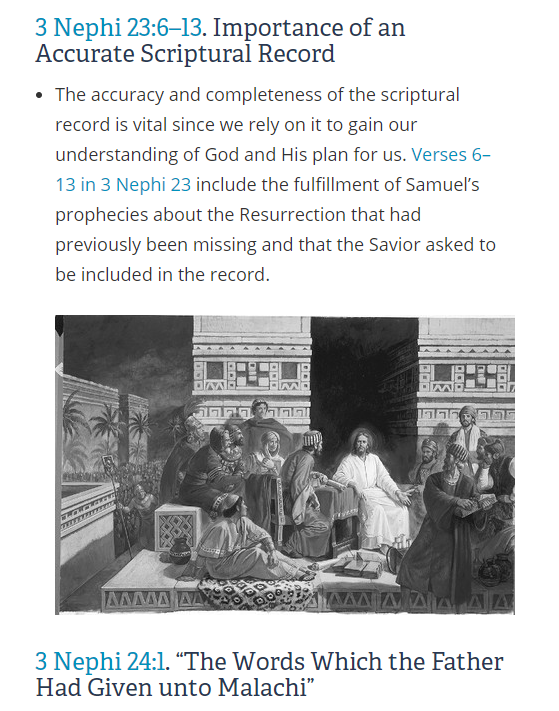
 This painting, titled "Christ Asks for the Records," specifically cites 3 Nephi 23. This is the passage where Christ, at the temple in Bountiful, meets with his twelve disciples and asks about their records.

You can see this here:
https://www.lds.org/media-library/images/bring-forth-the-record-39676?lang=eng

If you look closely, you can see several sets of gold plates and rolled up manuscripts in this painting.

The painting teaches, as clearly as art can teach, that Christ visited the twelve Nephite disciples in Mesoamerica. Of course, the New York Cumorah does not exclude any other location for Bountiful.

Except the M2C scholars who continue to promote Mesoamerica insist that the New York Cumorah is too far away to be the "real Cumorah." In fact, here's how a prominent BYU scholar described those Church members who still believe what the prophets and apostles have consistent taught.

BYU Professor John L. Sorenson, in Mormon’s Codex (Deseret Book, 2015), p. 688, writes “There remain Latter-day Saints who insist that the final destruction of the Nephites took place in New York, but any such idea is manifestly absurd. Hundreds of thousands of Nephites traipsing across the Mississippi Valley to New York, pursued (why?) by hundreds of thousands of Lamanites, is a scenario worthy only of a witless sci-fi movie, not of history.”

This ridicule of those who believe the prophets and apostles was published by Deseret Book and the Neal A. Maxwell Institute for Religious Scholarship at BYU.


A black and white version of Christ in Mesoamerica is included in the Book of Mormon Student Manual for Relition 121-122. (This manual also has Christ visiting the Nephites at a Mayan temple on the cover.)

You can see the painting here:

Note the irony of the lesson: "The accuracy and completeness of the scriptural record is vital since we rely on it to gain our understanding of God and His plan for us."

You might think the accuracy and completeness of the teachings of the prophets would also be vital, but it's not for the Correlation Department if those teachings contradict M2C. 


With artwork such as this, the Correlation Department is doing everything possible to imprint M2C on the minds of the Latter-day Saints, all the while pretending to be "neutral" about Book of Mormon geography.

Of course, if they were actually neutral, they would at least tell students (and missionaries and members generally) what the prophets have taught.

The Correlation Department, staffed by BYU/CES graduates, has implemented the teachings of the intellectuals instead of the teachings of the prophets. 
_____

The second painting is even more ubiquitous. Here's one of many sites where you can see it:


I've written about this one before:


There is nothing "neutral" about this painting at all, unless you want to consider Chichen Itza in the background, which wasn't built until around 600-900 A.D. Or maybe the mountains in the background represent Machu Picchu in Peru. I like to say that maybe the clouds represent North America.

But seriously, everything about this painting is wrong. The destruction occurred on the fourth day of the first month of the thirty and fourth year. But the painting shows rubble strewn on the steps even though Christ visited "in the ending of the thirty and fourth year." (3 Nephi 10:18) We think this means at the ending of the Jewish year in October, but that's another topic. The point is, the people had months to clean up and converse and repent, etc. 

Plus, the scripture says the people were gathered "round about the temple" when Christ visited. Yet this painting depicts the remnants of a decidedly non-Christian Mayan temple, with an intact Chichen Itza in the background.  

The best that can be said about this painting is that it depicts one of Christ's visits to his other people around the world, but it definitely doesn't depict a visit to a Nephite (Hebrew) temple.   

Nevertheless, the Correlation Department has made this the pre-eminent depiction of the Book of Mormon. http://bookofmormonwars.blogspot.com/2018/02/cumorah-6-education.html

It's no wonder that so many people are confused, and so many non-LDS won't take the Book of Mormon seriously.
_____
* M2C is the Mesoamerican/two-Cumorahs theory that teaches Joseph, Oliver and all the prophets and apostles who have taught Cumorah is in New York are wrong because the "real Cumorah" of Mormon 6:6 is somewhere in southern Mexico.

**It is a sound position to say we don't know where the other events took place because there are hundreds of possibilities for sites. In considering the dozens of named sites in the Book of Mormon, we'd have to choose among the million plus earthworks in North America.

Wednesday, June 6, 2018

English and more misleading translations

People who study the Book of Mormon in detail need to use the English version. All the translations I've looked at so far have problems because the translators were thinking "Central America."

This shouldn't be a surprise. English is the source language for the Book of Mormon. (Technically, the plates are, but we don't have access to them right now, so we have to work with the English text.)

The basic gospel principles are convened effectively into different languages, but in-depth study requires familiarity with English, just as those who study the Bible use the Greek and Hebrew. When I studied the New Testament in Greek, it quickly became apparent why there are so many variations among the translations.

Translating any language into another is a subjective effort in many respects. There are some words that translate clearly, but others that have no direct one-to-one correlation. In these cases, the translator has to clearly understand the ideas conveyed by the source document and then try to find a comparable expression in the new language. This creates two elements of subjectivity that readers in the new language usually aren't even aware of.

Unfortunately in the case of the Book of Mormon, official translations have been implemented with M2C in mind.

I've discussed how the translations of the Book of Mormon promote M2C* instead of accurately reflecting Joseph's English translation. The example I discussed was the translation of "head of Sidon," which is being translated into foreign languages as the "source of Sidon." This is not a translation but an interpretation, guided by M2C.
_____

A few weeks ago in France I was made aware of additional M2C spin in the translations.

Here is Helaman 13:4 in English:

4 And it came to pass that they would not suffer that he should enter into the city; therefore he went and got upon the wall thereof, and stretched forth his hand and cried with a loud voice, and prophesied unto the people whatsoever things the Lord put into his heart.

What was the wall made out of? The text doesn't specify. Could be stone, wood, earth, bricks--pretty much anything a wall can be made out of.

Here it is in French:

4 Et il arriva qu’ils ne voulurent pas lui permettre d’entrer dans la ville ; c’est pourquoi, il monta sur la muraille, et étendit la main, et cria d’une voix forte, et prophétisa au peuple ce que le Seigneur lui mettait dans le cœur.

The painting that leads translators to
interpret, not translate, the Book of Mormon
The French word "muraille" means not simply a wall (mur), but a bulwark, a thick wall, a vertical wall, masonry raised around a castle or city, etc. One commentator explained the difference this way:

"Mur" = any wall you may think of, including some barriers ("sound barrier" = "mur du son").
"Muraille" is never used for a house, even for a castle. It means something really huge and preferably very old and always made of stone, enclosing a stronghold, a town or a whole country. It is also sometimes used to describe a high cliff or a steep mountain slope.

A French member of the Church told me this term definitely means a stone wall. That's one reason why people who read the French translation think of Mesoamerica.

But it's an incorrect translation. In English, the text does not say it's a stone wall. Therefore, the French version is  an interpretation that I consider misleading.

I think the interpretation in this case was driven by the M2C artwork that the Correlation Department inflicts on members of the Church all around the world.
___

Necks.

M2C intellectuals always conflate the terms narrow neck, narrow neck of land, and small neck. I think they are different terms because they refer to different things.

But the distinction is removed in foreign translations.

Those who don't read English are reading the M2C spin, not the text Joseph translated.

Examples.

Alma 22:32 reads:

thus the land of Nephi and the land of Zarahemla were nearly surrounded by water, there being a small neck of land between the land northward and the land southward.

In French, the passage is translated like this:

c’est ainsi que le pays de Néphi et le pays de Zarahemla étaient presque entourés d’eau, une étroite bande de terre existant entre le pays situé du côté du nord et le pays situé du côté du sud.

Alma 63:5 reads:

therefore he went forth and built him an exceedingly large ship, on the borders of the land Bountiful, by the land Desolation, and launched it forth into the west sea, by the narrow neck which led into the land northward.

In French, it reads:

s’en fut construire un navire extrêmement grand dans les régions frontières du pays d’Abondance, près du pays de Désolation, et le lança dans la mer de l’ouest, près de la langue étroite qui menait au pays situé du côté du nord.

Ether 10:20 reads:

20 And they built a great city by the narrow neck of land, by the place where the sea divides the land.

In French, it is:

20 Et ils construisirent une grande ville près de la langue étroite de terre, près de l’endroit où la mer divise le pays.

If you don't read French, you can see that in all three cases, the French uses the term étroite, which means "narrow." You don't get the English distinction between "small" and "narrow." The M2C intellectuals say the terms are synonymous. That's possible, but they have different connotations that are lost in the French translation.

Again, this is an interpretation, not a translation.

Joseph (or Mormon/Moroni) used different terms. Why should the foreign translations use the same terms?

The French does use "bande" instead of "langue" here, which is an interesting choice. "Langue" means "tongue" or "language," but "langue de terre" means a "spit of land." Like a tongue, a spit of land is "a small point of land especially of sand or gravel running into a body of water."

"Bande" means a "strip" or "stripe."

Instead of a "small neck of land" we have a "narrow strip of land."

Instead of a "narrow neck" we have "a narrow tongue." A neck connects two bodies of water or earth, but a tongue extends from one without joining to another. This is a problem for any proposed geography.

In Alma 63:5, "by the narrow neck" becomes "near the narrow neck." This, too, loses the possible alternative meanings of the phrase, such as "through the narrow neck" or "in the vicinity of the narrow neck."

There are other examples, but this introduction hopefully will serve as a caution to non-English speaking members of the Church and investigators.
_____

As long as readers understand the M2C problem with these translations, they won't be misled because they can always refer to the original in English.

_____

* M2C is the acronym for the Mesoamerican/two-Cumorahs theory.


Tuesday, June 5, 2018

The gathering and the Book of Mormon

I suppose that everyone who reads this blog knows that last Sunday, President Russell M. Nelson told young people around the world that taking part in the gathering of Israel is their most important purpose right now. 

“There is nothing of greater consequence. Absolutely nothing,” he said. “This gathering should mean everything to you. This is the mission for which you were sent to earth.”

Joseph and Oliver receive the keys
in the Kirtland temple
Surely his counsel applies to every member of the Church. 

In 1836, Joseph Smith and Oliver Cowdery received the keys of the gathering: "the Heavens were again opened unto them and Moses appeared before them and committed unto them the Keys of the gathering of Israel from the four parts of the earth."

The prophets have consistently taught the importance of the gathering of Israel. We were instructed about this when I went on my mission many years ago.

President Nelson explained that “You and I are living to see, and will continue to see, Israel gathered with great power. “And you can be part of the power behind that gathering!”

This is the fulfillment of prophecy, and we're seeing it all around the world. Miracles are happening daily, as we all know and have experienced ourselves.

And yet, billions of people are not hearing the message. There are obstacles and impediments that we all hope to remove so more people will hear and accept the gospel message and be gathered in.

Forty years ago this coming October, President Ezra Taft Benson taught us that "The Book of Mormon is the instrument that God designed to 'sweep the earth as with a flood, to gather out [His] elect.' (Moses 7:62.) This sacred volume of scripture needs to become more central in our preaching, our teaching, and our missionary work."

In my view, one of the most serious impediments to the gathering of Israel is confusion about the Book of Mormon.

The tragedy is, we could remove this impediment simply by accepting the teachings of our prophets. But because of M2C, LDS intellectuals and employees at BYU/CES/COB refuse to accept what the prophets have taught.
_____

Imagine being a sincere investigator. A friend, or a missionary, tells you about the Book of Mormon--a sacred record of ancient people in the Americas who were visited by Jesus Christ after his ascension to heaven.

You're interested, but a little skeptical. You've never heard of this before, which seems strange because pretty much everyone in the world, regardless of his/her religion, has heard about Jesus Christ who lived in Israel. Surely, you think, you should have heard about Jesus visiting America.

You ask where Jesus came. Your friend, or the missionary, replies, "We don't know. Just somewhere in the Americas. He visited an ancient civilization called the Nephites but they were all killed off around 400 AD in a big battle with their enemies."

"Where did this happen?" you ask.

"In a place called Cumorah."

"Okay, then where was Cumorah?"

"I don't know. But I know the book is true."

If you were skeptical before, you're even more skeptical now. 

Your friend, or the missionary, says, "You can know the truth also. Just read this book and pray about it."

Maybe you will. Maybe you'll read the Book of Mormon and gain a spiritual witness and become one of the 1.7% of Americans who are LDS, or one of the 0.2% of the world's population who are LDS. 

But statistically, the overwhelming likelihood is that you will investigate a little before accepting the message. 

You go to the Internet. 

You discover there is quite a lot of discussion about this Cumorah place. You find Mormon and anti-Mormon web pages debating the issue. You find even Mormon web pages debating the issue. You end up at a site such as this: http://www.utlm.org/onlineresources/cumorah.htm

You quickly discover three things:

1. The Mormon prophets have consistently taught that Cumorah is in western New York. That gives you something to investigate further. 

2. You also learn that the Mormon prophets have said that they don't know the locations of other Book of Mormon places. But you know that there are still debates about the sites of Biblical events, too, so that's not a big deal.  

3. But then you learn that a lot of Mormons, even Mormon teachers at BYU, say their own prophets were wrong about Cumorah being in New York. They claim Cumorah is actually in Mesoamerica, or Baja, or Panama, or just about anyplace except New York. 

You think, "If Mormons don't believe their own prophets, why should I?"

The next time you hear from your friend (or the missionaries), you politely say you're not interested. You don't want to get into a debate that the Mormons themselves can't resolve.
_____

I agree with President Nelson that there is nothing more important than gathering Israel. 

I also agree with President Benson that the Book of Mormon is the instrument prepared to gather Israel.

For these reasons, I hope all members of the Church can unite in supporting and sustaining the teachings of the prophets about the New York Cumorah.